About 559 minutes
Commercial Law — A Reader’s Guide
Science Fiction Utopias
128,536 recorded words. 28 minutes difference from this book's estimate.
View Gutenberg source #42241
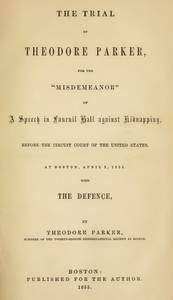
This digital edition of The Trial of Theodore Parker For the "Misdemeanor" of a Speech in Faneuil Hall against Kidnapping, before the Circuit Court of the United States, at Boston, April 3, 1855 — Text and Context is described by source-level measurements including 122,111 words, 8 hr 51 min estimated reading time, and 15 detected text sections.
The text analysis averages about 21.5 words per sentence, while the detected sections provide another way to judge how the source is divided.
Project Gutenberg metadata also associates the work with “United States -- Fugitive slave law (1850),” connecting these edition facts with the source record’s subject description.
Explore this collection
These alternatives are selected using recorded categories and estimated reading time.
About 559 minutes
Science Fiction Utopias
128,536 recorded words. 28 minutes difference from this book's estimate.
View Gutenberg source #42241About 612 minutes
Science Fiction Utopias
140,634 recorded words. 81 minutes difference from this book's estimate.
View Gutenberg source #63830About 628 minutes
Science Fiction Utopias
144,373 recorded words. 97 minutes difference from this book's estimate.
View Gutenberg source #46746Search stored excerpts and compare books → Choose by your preferences →
Choices use stored catalog measurements. Estimates vary with reading speed. A shared category is a catalog label, not a claim that two books have the same argument or literary quality.
Search reads excerpt text stored with this catalog and links to its associated Gutenberg record. The connection is stored in the site database; this tool does not recheck that every excerpt is word-for-word identical to that external record. Excerpt search does not cover every chapter and does not verify historical publication dates.
Catalog snapshot checked: 2026-09-25. Coverage: 90 public books, 90 available source excerpts.
Calculated from edition completeness, EPUB availability, text structure and catalogue metadata. Not a user rating.
Total of 100 points, scaled to a 2.5-5.0 range. Editions with an empty description or a missing EPUB file are not scored.
Public-domain source text
The source text is kept in the dedicated reader, separate from this catalogue record and its commentary.
Theodore Parker's published defence, The Trial of Theodore Parker, is not a transcript of courtroom proceedings but a carefully constructed argument that moves between legal reasoning, historical analogy, and moral exhortation. The work opens with a preface addressed to the people of the free states, framing the case as a matter of 'the great Human Right to Freedom of Speech' rather than a personal grievance. Parker describes preparing his 'line of defence' and 'fortifications' within days of Judge Curtis's charge to the grand jury, using martial language that recurs throughout the text. The structure alternates between close analysis of legal precedents—such as the Fries treason case—and broader reflections on the Fugitive Slave Law's threat to liberty.
Parker organizes his defence as a layered argument, moving from immediate legal circumstances to sweeping historical parallels. The preface establishes a personal timeline: after Judge Curtis's charge on June 7, 1854, Parker 'made ready for trial' and 'began to collect arms.' This martial metaphor—fortifications, batteries, attack—recurs when he later describes judges as wielding 'the sword of constituted authority.' The defence itself is not a single speech but a compilation of legal citations, historical narratives, and rhetorical appeals. Parker frequently breaks his argument to insert extended quotations from earlier cases, such as the trial of John Fries for treason in 1799, where he notes the government's 'usual ingenuity of officials working by the job.' These embedded histories serve as both precedent and warning, creating a structure that mirrors a legal brief while retaining the urgency of an oration.
Throughout the text, Parker returns to the language of kidnapping and enslavement to describe the Fugitive Slave Law's enforcement. The title itself names the 'misdemeanor' of a speech 'against kidnapping,' and the preface frames the grand jury's actions as tools of 'the Slave Power.' In the historical section on Judge Chase, Parker describes him as a figure who 'employ with resolute audacity the engine of popular revolt' and later wields 'the sword of constituted authority.' This image of judicial figures as alternately mob leaders and despots recurs when Parker contrasts 'Kidnapping Whigs' with 'privateering Democrats.' The physical act of seizure—taking a person from free soil—becomes a metaphor for legal overreach, as when Parker quotes Judge Peters's ruling that 'the quantum of force is immaterial' in treason cases, implying that even a word can be construed as violent. The repetition of 'kidnapping' and 'slave power' ties the legal argument to a visceral, bodily threat.
Parker shifts rapidly between the immediate context of his own trial and earlier episodes of judicial overreach. After describing his preparation for trial, he leaps to the 1790s, detailing the Alien and Sedition Laws and the prosecution of John Fries. The transition is abrupt: 'But tyranny did not end; nay, he himself... became a most atrocious example of Judicial despotism.' This movement is not linear but associative, linking Judge Curtis to Judge Iredell and Judge Chase through a chain of legal abuses. Parker uses this structure to argue that the Fugitive Slave Law is not an isolated statute but part of a pattern. He quotes Judge Iredell's charge that the government had been 'grossly abused,' then immediately notes that Iredell had defended the Alien and Sedition Laws. The effect is to collapse historical distance, making the reader feel that the same struggle recurs in each generation.
Parker's voice oscillates between that of a legal scholar and a moral preacher. In the preface, he addresses 'Fellow-Citizens and Friends' with the directness of a sermon, yet the body of the defence is dense with citations and footnotes. He describes his own role as a minister—'Minister of the Twenty-Eighth Congregational Society in Boston'—and the dedication lists 'magnanimous lawyers' alongside historical figures like Holt and Erskine. This dual identity shapes the text's tone: Parker can shift from dry legal analysis ('The Judiciary Act of Congress of 1789 provides...') to rhetorical condemnation ('a most atrocious example of Judicial despotism'). The recurring phrase 'Gentlemen' in the historical sections suggests an imagined courtroom audience, even when the actual trial never reached a verdict. This blending of roles—defendant, historian, preacher—gives the defence a layered, almost polyphonic quality.
Readers approaching The Trial of Theodore Parker should attend to how the text weaves together legal citation, historical narrative, and personal testimony. Parker's defence is as much a work of political philosophy as a courtroom document, and its structure—moving from the specific to the general and back—reflects his belief that the Fugitive Slave Law was not a legal anomaly but a symptom of a recurring threat to liberty. The book rewards careful reading of its footnotes and embedded quotations, which Parker uses to build a cumulative case against judicial overreach.
I keep thinking about Parker’s quiet fury, how he turned a courtroom into a mirror for the nation’s conscience. It stayed with me long after, the weight of someone speaking truth when the law itself had gone crooked. That same ache surfaced again in Facing the chair — Reading Notes, where dignity meets an even harder silence. Both left me holding my breath, gently.
Your answers remain private and are stored only in this browser.