About 797 minutes
The Life of John Marshall, Volume 3: Conflict and construction, 1800-1815 — Edition Insights
Science Fiction Utopias
183,266 recorded words. 119 minutes difference from this book's estimate.
View Gutenberg source #40445
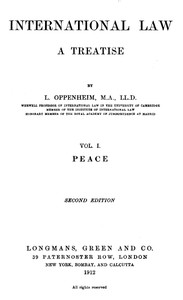
For International Law. A Treatise. Volume 1 (of 2) Peace. Second Edition — A Reader’s Guide, the stored edition analysis reports 210,452 words, 15 hr 16 min estimated reading time, and 48 detected text sections.
The text analysis averages about 20.1 words per sentence, while the detected sections provide another way to judge how the source is divided.
Project Gutenberg metadata also associates the work with “International law,” connecting these edition facts with the source record’s subject description.
Explore this collection
These alternatives are selected using recorded categories and estimated reading time.
About 797 minutes
Science Fiction Utopias
183,266 recorded words. 119 minutes difference from this book's estimate.
View Gutenberg source #40445About 791 minutes
Science Fiction Utopias
181,812 recorded words. 125 minutes difference from this book's estimate.
View Gutenberg source #74804About 718 minutes
Science Fiction Utopias
165,045 recorded words. 198 minutes difference from this book's estimate.
View Gutenberg source #78301Search stored excerpts and compare books → Choose by your preferences →
Choices use stored catalog measurements. Estimates vary with reading speed. A shared category is a catalog label, not a claim that two books have the same argument or literary quality.
Search reads excerpt text stored with this catalog and links to its associated Gutenberg record. The connection is stored in the site database; this tool does not recheck that every excerpt is word-for-word identical to that external record. Excerpt search does not cover every chapter and does not verify historical publication dates.
Catalog snapshot checked: 2026-09-25. Coverage: 90 public books, 90 available source excerpts.
Calculated from edition completeness, EPUB availability, text structure and catalogue metadata. Not a user rating.
Total of 100 points, scaled to a 2.5-5.0 range. Editions with an empty description or a missing EPUB file are not scored.
Public-domain source text
The source text is kept in the dedicated reader, separate from this catalogue record and its commentary.
Oppenheim's second edition of International Law. A Treatise. Volume 1 (of 2) Peace (1912) is a systematic legal exposition that reveals its author's method through its very structure. The preface explains that new topics—such as wireless telegraphy on the open sea and the utilisation of river flow—are inserted between existing sections using lettered subsections (e.g., § 178a), a technique that preserves the original numbering while accommodating change. This editorial choice mirrors the treatise's central tension: the law must be both stable and responsive to technological and political developments.
Oppenheim's treatment of the open sea demonstrates his reliance on precise geographical and legal criteria. He defines the open sea as 'the general body of salt water extending over the globe,' provided its navigable connections are open to all nations. This leads to counterintuitive classifications: the Sea of Marmora is part of the open sea despite being surrounded by Turkish land, because the Bosphorus and Dardanelles are open to merchantmen. Conversely, the Sea of Azoff is Russian territory because the Strait of Kertch is not internationally open. Oppenheim cites conflicting authorities—Rivier and Martens versus Stoerk—on whether the Sea of Azoff is open sea, showing that even established rules admit debate. The section includes a long list of seas, gulfs, and bays that belong to the open sea, but acknowledges that 'it is doubtful as regards many gulfs and bays whether they belong to the Open Sea or are territorial.' This hedging reflects the treatise's careful, evidence-based approach.
The principle of freedom of the open sea is stated in absolute terms: 'the Open Sea is not and never can be under the sovereignty of any State whatever.' Oppenheim draws on a wide range of authorities—Hall, Westlake, Lawrence, Twiss, Moore, and many continental jurists—to support this rule. The section's bibliography lists over twenty sources, indicating the depth of his research. He emphasizes that no state may exercise legislation, administration, or jurisdiction over the open sea as a rule. Yet the treatise's own structure, with its new sections on wireless telegraphy and mines in the subsoil of the seabed, hints at emerging challenges to this freedom. Oppenheim does not speculate on future conflicts; instead, he documents the current legal consensus and notes where disagreements exist, such as the Russian claim that the Kara Sea is territorial, which he refutes by citing Martens.
The preface to the second edition is itself a revealing document. Oppenheim states that 'the course of events since 1905' and 'the results of further research' necessitated thorough revision. He quantifies the changes: new matter amounts to 'nearly a quarter of the former work,' yet the book remains 'not less convenient in size' through typographical adjustments—using a line extra on each page, more words per line, and smaller type for bibliography and notes. The appendix was omitted to make room. This attention to physical format underscores the treatise's practical orientation. New sections address specific incidents (the Casa Blanca incident) and institutions (the International Prize Court, a suggested International Court of Justice). The numbering system—inserting § 178a, § 287a, etc.—allows the reader to see exactly what is new, preserving the original architecture while signaling change. Oppenheim's method is transparent: he does not rewrite history but layers it.
Readers approaching this treatise should attend to its dual character: it is both a snapshot of international law in 1912 and a document of how legal scholarship adapts to new realities. The lettered subsections, the detailed footnotes, and the careful demarcation of disputed points all reward close reading. Oppenheim's work is not a narrative but a system; its value lies in the precision of its distinctions and the honesty of its uncertainties.
Oppenheim's tidy scheme for peace—wireless waves, river courses—always felt like shelving order for a restless world. I think of the other volume, where law meets its human rupture, a Boston courtroom’s raw speech against kidnapping. Both share a quiet faith that procedure and argument might hold back chaos. The Trial of Theodore Parker For the "Misdemeanor" of a Speech in Faneuil Hall against Kidnapping, before the Circuit Court of the United States, at Boston, April 3, 1855 — Text and Context sits beside it now, a stubborn reminder that peace is always personal.
Your answers remain private and are stored only in this browser.