About 247 minutes
The Indian Question — Background and Themes
Science Fiction Utopias
56,727 recorded words. 41 minutes difference from this book's estimate.
View Gutenberg source #27058
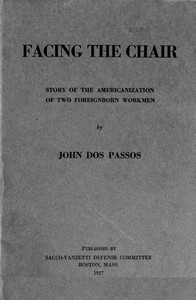
Before opening Facing the chair — Reading Notes, the edition data offers a quick orientation: 47,156 words, 3 hr 26 min estimated reading time, and 18 detected text sections.
The text analysis averages about 20.9 words per sentence, while the detected sections provide another way to judge how the source is divided.
Project Gutenberg metadata also associates the work with “Sacco, Nicola, 1891-1927,” connecting these edition facts with the source record’s subject description.
Explore this collection
These alternatives are selected using recorded categories and estimated reading time.
About 247 minutes
Science Fiction Utopias
56,727 recorded words. 41 minutes difference from this book's estimate.
View Gutenberg source #27058About 163 minutes
Science Fiction Utopias
37,419 recorded words. 43 minutes difference from this book's estimate.
View Gutenberg source #17449About 273 minutes
Science Fiction Utopias
62,624 recorded words. 67 minutes difference from this book's estimate.
View Gutenberg source #686Search stored excerpts and compare books → Choose by your preferences →
Choices use stored catalog measurements. Estimates vary with reading speed. A shared category is a catalog label, not a claim that two books have the same argument or literary quality.
Search reads excerpt text stored with this catalog and links to its associated Gutenberg record. The connection is stored in the site database; this tool does not recheck that every excerpt is word-for-word identical to that external record. Excerpt search does not cover every chapter and does not verify historical publication dates.
Catalog snapshot checked: 2026-09-25. Coverage: 90 public books, 90 available source excerpts.
Calculated from edition completeness, EPUB availability, text structure and catalogue metadata. Not a user rating.
Total of 100 points, scaled to a 2.5-5.0 range. Editions with an empty description or a missing EPUB file are not scored.
Public-domain source text
The source text is kept in the dedicated reader, separate from this catalogue record and its commentary.
John Dos Passos's Facing the Chair opens not with his own words but with two appeals: Anatole France's plea to the American people and Eugene V. Debs's final call for justice. France's letter, dated October 31, 1921, warns that executing Sacco and Vanzetti will 'make martyrs of them and cover you with shame.' Debs's statement, written after the Supreme Judicial Court of Massachusetts denied a new trial, declares the decision 'accords perfectly with the tragical farce and the farcical tragedy of the entire trial.' These prefatory pieces establish the book's documentary character and its polemical stance.
The main text then begins with the subtitle 'Story of the Americanization of two foreignborn workmen,' signaling that Dos Passos will frame the case as a narrative about immigration and labor. The first chapter, 'The Plymouth Trial of Vanzetti Alone,' immediately challenges the notion that Vanzetti had a criminal record by detailing his role in a 1916 strike at the Plymouth Cordage Company.
The book's organization reflects its origins as a defense committee publication. After the opening appeals, Dos Passos presents a chronological account interspersed with letters from the defendants and excerpts from trial testimony. The chapter on Vanzetti's Plymouth trial includes a long quotation from a letter Vanzetti wrote to friends in Mexico, in which he describes his defense attorney's behavior: 'he began to promise me the electric chair' and would 'cease to speak, to begin to whistle, tracing upward spiral motions with his right hand.' This direct incorporation of Vanzetti's voice gives the reader access to the defendant's perspective, a technique Dos Passos uses throughout.
The narrative moves between third-person exposition and first-person documents, creating a mosaic of perspectives. The reader encounters not only the legal arguments but also the human cost, as when Dos Passos notes that Vanzetti was 'the only employee who did not get his job back when the strike was settled.' This alternation between factual reporting and personal testimony is the book's central structural device.
Dos Passos grounds the case in the economic realities of immigrant labor. He describes the Plymouth Cordage Company as 'the largest in the world' and notes that it 'virtually owns Plymouth and the surrounding towns.' Italian and Portuguese workers earned 'at that time for a maximum of nine dollars a week' tending machines that processed hemp from Yucatan. The 1916 strike, the first in the company's history, shut down the plant for a month during the busiest season and resulted in a raise, but Vanzetti was blacklisted.
This economic detail is not incidental; it establishes the backdrop against which the legal proceedings unfold. Dos Passos implies that Vanzetti's union activity made him a target. The description of the strike and its aftermath occupies several paragraphs, and the reader is invited to see the trial as part of a larger pattern of labor suppression. The book does not argue this point explicitly in the early chapters but lets the facts accumulate.
The narrative then turns to the Bridgewater holdup, an attempted payroll robbery that preceded the South Braintree murder. Dos Passos provides a precise timeline: the attack occurred at 7:35 A.M. on 'the day before Christmas 1919.' The truck had obtained $33,000 from a bank and was traveling north on Broad Street when it was ambushed. The description of the route—past a trolley track, near Hale Street, and by railroad tracks—creates a sense of concrete geography.
Dos Passos notes that Sacco could not be implicated in this crime because he was working that day, but Vanzetti, being self-employed, could not provide an alibi. The chapter raises the possibility that Vanzetti's defense attorney 'deliberately gave away his client's case' by failing to file a bill of exceptions and refusing to let Vanzetti testify. This allegation, supported by Vanzetti's own letter, is one of the book's most damning claims about the trial's fairness.
Facing the Chair was published in 1927, before the executions, and its purpose was to sway public opinion. The reader should approach it as a work of advocacy rather than a neutral history. Dos Passos selects and arranges evidence to support the defendants' innocence, and he does not include counterarguments from the prosecution. The book's value lies in its preservation of primary sources—letters, trial excerpts, and appeals—that might otherwise be lost.
The reader may wish to compare Dos Passos's account with other contemporary sources, such as newspaper reports or the official trial transcript. The book's structure, moving from the Plymouth trial to the Bridgewater case and then to the joint trial, mirrors the legal chronology but also builds a cumulative case. Pay attention to the dates and locations mentioned; they anchor the narrative in specific events. The book is best read as a piece of historical testimony, not a definitive legal analysis.
Dos Passos's account is a reminder that the Sacco-Vanzetti case was not only a legal drama but also a cultural flashpoint. The book's documentary style—its use of letters, appeals, and trial excerpts—gives the reader direct access to the voices of the defendants and their supporters. For a first reading, focus on how Dos Passos weaves these materials into a narrative that is both factual and impassioned. The book is a primary source in its own right, reflecting the passions and arguments of its time.
The rain tapped the window that afternoon while I sat with Dos Passos’s account of Sacco and Vanzetti, the weight of their letters settling in my chest. Later, pulling down a dusty volume, I found the same quiet urgency about justice and belonging. The Indian Question — Background and Themes lingered there, waiting, as if the rain had led me somewhere else entirely.
A brief reflection can help important ideas stay with you longer.