About 612 minutes
Medical Jurisprudence, Volume 2 (of 3) — Themes and Context
Science Fiction Utopias
140,634 recorded words. 16 minutes difference from this book's estimate.
View Gutenberg source #63830
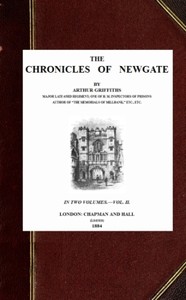
The catalog record for The Chronicles of Newgate, vol. 2/2 — Key Ideas to Explore provides practical reading context through 144,373 words, 10 hr 28 min estimated reading time, and 17 detected text sections.
The text analysis averages about 20.7 words per sentence, while the detected sections provide another way to judge how the source is divided.
Project Gutenberg metadata also associates the work with “Criminals -- Great Britain,” connecting these edition facts with the source record’s subject description.
Explore this collection
These alternatives are selected using recorded categories and estimated reading time.
About 612 minutes
Science Fiction Utopias
140,634 recorded words. 16 minutes difference from this book's estimate.
View Gutenberg source #63830About 681 minutes
Science Fiction Utopias
156,543 recorded words. 53 minutes difference from this book's estimate.
View Gutenberg source #63241About 559 minutes
Science Fiction Utopias
128,536 recorded words. 69 minutes difference from this book's estimate.
View Gutenberg source #42241Search stored excerpts and compare books → Choose by your preferences →
Choices use stored catalog measurements. Estimates vary with reading speed. A shared category is a catalog label, not a claim that two books have the same argument or literary quality.
Search reads excerpt text stored with this catalog and links to its associated Gutenberg record. The connection is stored in the site database; this tool does not recheck that every excerpt is word-for-word identical to that external record. Excerpt search does not cover every chapter and does not verify historical publication dates.
Catalog snapshot checked: 2026-09-25. Coverage: 90 public books, 90 available source excerpts.
Calculated from edition completeness, EPUB availability, text structure and catalogue metadata. Not a user rating.
Total of 100 points, scaled to a 2.5-5.0 range. Editions with an empty description or a missing EPUB file are not scored.
Public-domain source text
The source text is kept in the dedicated reader, separate from this catalogue record and its commentary.
Arthur Griffiths, a former prison inspector, writes The Chronicles of Newgate, vol. 2/2 with a dual voice: that of a historian compiling records and that of an official who has observed the system firsthand. The narrative shifts between brisk summaries of penal policy and extended, almost novelistic accounts of individual criminals. In the chapter on crimes and criminals, the prose accelerates through lists of offenses—forgery, coining, highway robbery—then slows to dwell on the downfall of banker Henry Fauntleroy, whose forged powers of attorney are described with legal precision. This alternation between catalogue and case study shapes the reader's experience of the book's pace.
Griffiths structures his early chapters as a series of rapid-fire summaries. The opening of Chapter I lists crimes and punishments in short, declarative sentences: “Newgate full—Executions very numerous—Ruthless penal code.” This staccato style mimics the relentless frequency of executions and the mechanical operation of the law. When he turns to specific offenders, however, the tempo changes. The account of Charles Price, alias Old Patch, unfolds with circumstantial detail—his disguises, his methods of passing forged notes—that slows the narrative to a deliberate pace. The reader is made to feel the difference between statistical overview and individual story, a contrast that Griffiths exploits throughout the volume.
The longest sustained passage in the excerpts concerns banker Henry Fauntleroy, whose forgeries are narrated partly through his own written declaration: “In order to keep up the credit of our house, I have forged powers of attorney.” Griffiths reproduces this first-person statement without interruption, letting Fauntleroy’s voice dominate. The surrounding prose then shifts to a more measured, judicial tone, quoting a newspaper description of the prisoner’s “most subdued resignation.” This layering of voices—the criminal’s justification, the press’s pathos, the author’s factual summary—creates a polyphonic effect rare in earlier chapters. The pacing slows further as Griffiths details the discovery of the fraud, the run on the bank, and the public scandal, building toward the trial with novelistic suspense.
Later chapters, such as “Philanthropy in Newgate” and “The Beginnings of Prison Reform,” adopt a more expository rhythm. Sentences lengthen, and the focus shifts from individual criminals to institutional change. Griffiths describes the work of reformers like Elizabeth Fry with a steadier, less sensational tempo. The language becomes administrative: “the first report of the inspectors of prisons” is treated as a turning point. This deceleration mirrors the shift from the chaotic, violent world of early nineteenth-century crime to the ordered, bureaucratic prison system Griffiths himself helped oversee. The reader moves from the gallows to the committee room, and the prose adjusts accordingly.
Griffiths’s volume rewards attention to its shifts in register—from the clipped urgency of crime lists to the measured cadence of reform chronicles. Readers may find it useful to note how the author’s own professional experience as an inspector colors his treatment of penal history, particularly in the later chapters. The excerpts suggest a work that is as much about the telling of crime as about crime itself, a dual focus that gives the book its distinctive texture.
Reading Arthur Griffiths trace Newgate’s shift from lurid gallows prose to quieter reform records, I found myself thinking of the older scaffold’s shadow — how Tyburn Tree: Its History and Annals — Themes and Context lingers on that same hush before a crowd’s roar. Tyburn Tree: Its History and Annals — Themes and Context feels like a patient echo of that transition, a pause where spectacle once screamed. Strange, how a penal archive can sound almost like a sigh.
A brief reflection can help important ideas stay with you longer.