About 439 minutes
Trial of Mary Blandy — Text and Context
Adventure Picaresque Fiction
100,940 recorded words. 7 minutes difference from this book's estimate.
View Gutenberg source #12640
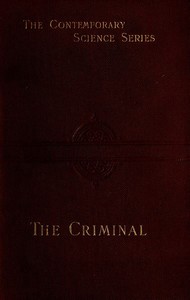
For The Criminal — Themes and Context, the stored edition analysis reports 99,322 words, 7 hr 12 min estimated reading time, and 11 detected text sections.
The text analysis averages about 21.2 words per sentence, while the detected sections provide another way to judge how the source is divided.
Project Gutenberg metadata also associates the work with “Criminal anthropology,” connecting these edition facts with the source record’s subject description.
Explore this collection
These alternatives are selected using recorded categories and estimated reading time.
About 439 minutes
Adventure Picaresque Fiction
100,940 recorded words. 7 minutes difference from this book's estimate.
View Gutenberg source #12640About 475 minutes
Adventure Picaresque Fiction
109,107 recorded words. 43 minutes difference from this book's estimate.
View Gutenberg source #40966About 367 minutes
Adventure Picaresque Fiction
84,317 recorded words. 65 minutes difference from this book's estimate.
View Gutenberg source #64898Search stored excerpts and compare books → Choose by your preferences →
Choices use stored catalog measurements. Estimates vary with reading speed. A shared category is a catalog label, not a claim that two books have the same argument or literary quality.
Search reads excerpt text stored with this catalog and links to its associated Gutenberg record. The connection is stored in the site database; this tool does not recheck that every excerpt is word-for-word identical to that external record. Excerpt search does not cover every chapter and does not verify historical publication dates.
Catalog snapshot checked: 2026-09-25. Coverage: 90 public books, 90 available source excerpts.
Calculated from edition completeness, EPUB availability, text structure and catalogue metadata. Not a user rating.
Total of 100 points, scaled to a 2.5-5.0 range. Editions with an empty description or a missing EPUB file are not scored.
Public-domain source text
The source text is kept in the dedicated reader, separate from this catalogue record and its commentary.
Havelock Ellis's The Criminal (1890) opens with a preface that positions itself as a critical summary of criminal anthropology, a science then fifteen years old. Ellis notes that no English book had yet addressed the subject, and he presents his work as a compilation of European research, disclaiming originality. The table of contents reveals a systematic structure: chapters on physical characteristics (cranial features, face, hair, tattooing, motor activity) and psychical traits (moral insensibility, vanity, emotional instability, religion, thieves' slang, prison inscriptions, criminal literature and philosophy).
The early chapters catalog physical anomalies attributed to criminals. Ellis draws on Lombroso and others to describe cranial and cerebral characteristics, facial asymmetries, and anomalies of hair. The section on tattooing (Chapter III, §7) treats it as a diagnostic marker, noting its prevalence and symbolic content. Ellis also discusses heredity and physical sensibility, measuring pain responses. These passages are dense with measurements and classifications, reflecting the era's positivist faith in quantifiable data. Readers should note that Ellis presents these as findings from multiple studies, not his own fieldwork, and the excerpts do not include his critical evaluation of these methods.
Chapter IV shifts to psychical traits. Ellis enumerates moral insensibility, intelligence (often described as cunning but narrow), vanity, and emotional instability. He cites prison inscriptions and thieves' slang as evidence of a distinct subculture. A notable passage discusses the criminal's lack of remorse and tendency to justify crime as a duty or a response to social hypocrisy. Ellis quotes a prisoner who calls society "a game of rogue catch rogue" and an Italian thief who declares he only takes from the rich. These voices give the criminal a platform, though Ellis frames them as data points within a typology.
In the section on criminal philosophy, Ellis assembles statements from criminals that rationalize their actions. A Milanese thief says, "I do not rob; I merely take from the rich their superfluities." The murderer Raynal writes that "three-fourths of the social virtues are cowardly vices." An Italian thief named Rosati boasts of attacking large sums as "a speculation rather than a theft." Ellis also includes a prison inscription: "Law for the rich but none for the poor." These quotations reveal a consistent pattern of moral inversion, where the criminal sees society as the true rogue. Ellis does not endorse these views but presents them as essential for understanding the criminal's mindset.
Later chapters address the results of criminal anthropology and the treatment of the criminal. Ellis discusses the implications of determinism versus free will, and reviews proposals for penal reform, including the Elmira system in New York. The appendices include a congress report and case studies. The excerpts do not reveal Ellis's final conclusions, but the structure suggests he aims to bridge descriptive science and practical policy. Readers should note that the book is a synthesis, not a monograph, and that Ellis's own voice emerges most clearly in the preface and transitional passages.
As a first reader, attend to how Ellis balances empirical claims with the voices of criminals themselves. The book is less a unified argument than a compendium of late-nineteenth-century European research, with all its assumptions and biases. The excerpts offer a window into the criminological thinking that shaped early criminal justice reform. Treat the quoted prisoners' words as artifacts of a contested discourse, not as transparent confessions.
I kept thinking about how Havelock Ellis tried to understand the criminal's own justifications, those quiet self-narratives scratched into prison walls. It made me remember how Chronicles of Newgate felt similarly—not judging, just sitting with what people say about themselves when trapped. That lingering quality stayed with me, and I think it stayed with you too. Chronicles of Newgate, Vol. 2 From the eighteenth century to its demolition — Themes and Context carries that same weight.
A brief reflection can help important ideas stay with you longer.