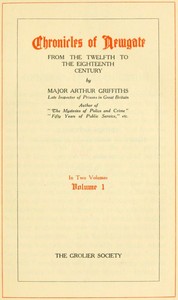
Arthur Griffiths opens Chronicles of Newgate, Vol. 2 by positioning the prison as a representative case of early English incarceration, calling it 'the physical expression of manifold neglect and mismanagement.' The introduction immediately grounds the reader in sensory detail: subterranean cells where prisoners fought rats for food, open sewers running through floors, and a daily water allowance of only three pints per person. Griffiths relies on the investigations of John Howard and parliamentary committees, weaving their statistics into a narrative that is both documentary and accusatory.
The Architecture of Suffering
Griffiths devotes considerable attention to the physical fabric of Newgate, treating its design as a direct cause of misery. He describes underground dungeons, or 'oubliettes,' into which prisoners were lowered through trapdoors, and notes that windows were seldom opened, if they existed at all. The absence of ventilation, chimneys, and bedding is catalogued with precision: inmates slept on 'heaps of filthy rags or bundles of rotten straw.' Water was rationed so severely that three pints per head per day was considered generous, and at some prisons it could only be purchased—'a halfpenny for three gallons.' These details are not merely atmospheric; they serve as evidence for Griffiths's argument that the built environment was deliberately punitive.
Mingling the Condemned and the Reckless
A recurring theme in the excerpts is the failure to separate prisoners by age, crime, or mental state. Griffiths reports that 'all classes of the condemned' were crowded together in the press-yard, with as many as sixty men sharing the space. The better-disposed inmates complained that the 'language of the condemned rooms was disgusting' and that prayer was impossible amid the noise. Even those awaiting execution were forced to associate with lighter-hearted prisoners who played 'blind-man's-buff and leap-frog' or beat each other with knotted handkerchiefs. Griffiths notes that this indiscriminate association lasted for months, exposing the condemned to 'mockery' and preventing any serious reflection.
The Unfortunate Lunatics
Griffiths highlights the presence of criminal lunatics as a further degradation of prison discipline. Although the law allowed for their removal to asylums, these powers were 'not invariably put in force.' At the time of a Lords' Committee investigation, eight lunatics were held in Newgate, and a return listed thirty-nine across various gaols, some detained for years: five years at Newgate and York Castle, seven at Ilchester and Morpeth, and as long as twenty-four years at Pembroke. Griffiths argues that detaining such persons in a common prison was 'manifestly wrong,' both for their own suffering and for the disruption they caused to order. The passage underscores the systemic indifference to mental illness within the penal system.
Voices from the Records
Griffiths's authorial method is to let official documents and prisoner testimony speak. He quotes a man who said he was 'dying a death every day' from forced association with brutal companions. He cites John Howard's findings on water allowances and food rations—'bread boiled in mere water'—without embellishment. The prose is factual, but the accumulation of specific numbers and locations creates a cumulative indictment. Griffiths rarely editorializes; instead, he presents the evidence and allows the reader to draw conclusions. This approach gives the work the authority of a parliamentary report while maintaining a narrative drive.
Griffiths's second volume is best approached as a work of forensic social history. Readers should attend to the interplay between statistical data and anecdotal testimony, noting how the author uses both to construct a case against the prison system. The excerpts do not reveal whether Griffiths offers solutions or follows the prison through to its demolition, but the pattern of evidence suggests a steady accumulation of horrors leading to reform. Those interested in the history of punishment will find a meticulous, if grim, chronicle of institutional failure.
Reading about Newgate’s cold, indifferent record-keeping brought back an afternoon spent in an old solicitor’s office, where ledgers of estate accounts sat untouched for decades. The way Griffiths lingers on bureaucratic neglect felt hauntingly familiar, like the quiet patience I found in De Mortuis Nil Nisi Bona Being a Series of Problems in Executorship Law and Accounts — Story, Setting & Ideas, where even the dread of final settlements carries a hushed, almost tender weight.