About 365 minutes
Studies in Forensic Psychiatry — Inside the Classic
Adventure Picaresque Fiction
83,816 recorded words. 2 minutes difference from this book's estimate.
View Gutenberg source #19168
For Judgments in Vacation — Story, Setting & Ideas, the stored edition analysis reports 84,317 words, 6 hr 7 min estimated reading time, and 22 detected text sections.
The text analysis averages about 25.3 words per sentence, while the detected sections provide another way to judge how the source is divided.
Project Gutenberg metadata also associates the work with “Law -- Great Britain -- Anecdotes,” connecting these edition facts with the source record’s subject description.
Explore this collection
These alternatives are selected using recorded categories and estimated reading time.
About 365 minutes
Adventure Picaresque Fiction
83,816 recorded words. 2 minutes difference from this book's estimate.
View Gutenberg source #19168About 340 minutes
Adventure Picaresque Fiction
78,177 recorded words. 27 minutes difference from this book's estimate.
View Gutenberg source #50514About 333 minutes
Adventure Picaresque Fiction
76,532 recorded words. 34 minutes difference from this book's estimate.
View Gutenberg source #48792Search stored excerpts and compare books → Choose by your preferences →
Choices use stored catalog measurements. Estimates vary with reading speed. A shared category is a catalog label, not a claim that two books have the same argument or literary quality.
Search reads excerpt text stored with this catalog and links to its associated Gutenberg record. The connection is stored in the site database; this tool does not recheck that every excerpt is word-for-word identical to that external record. Excerpt search does not cover every chapter and does not verify historical publication dates.
Catalog snapshot checked: 2026-09-25. Coverage: 90 public books, 90 available source excerpts.
Calculated from edition completeness, EPUB availability, text structure and catalogue metadata. Not a user rating.
Total of 100 points, scaled to a 2.5-5.0 range. Editions with an empty description or a missing EPUB file are not scored.
Public-domain source text
The source text is kept in the dedicated reader, separate from this catalogue record and its commentary.
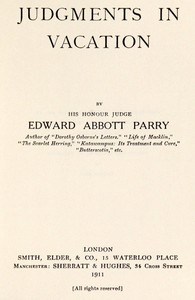
Sir Edward Abbott Parry, a County Court judge, opens his preface with a self-deprecating analogy: the emancipated slave who buys a share in another slave, or the bus-driver who spends his holiday driving for a sick friend. He confesses that the habit of delivering judgments persists even in vacation, when he finds himself alone with pen and paper. This collection of essays, published in 1911, is not a formal legal treatise but a series of reflections on topics ranging from the disadvantages of education to the prevalence of Podsnappery—a term borrowed from Dickens's Our Mutual Friend.
Parry's essay on Podsnappery reveals his interest in the nuances of public speech. He quotes a “Town Vicar” who complains about a Dean using the phrase “not going to take it lying down” and Bishops referring to the “bottom dog.” Parry defends the Dean's sporting metaphor but is more ambivalent about the Bishops' language, noting that the vicar would prefer the euphemisms “submerged tenth” or “our poorer brethren.” He then recounts an anecdote about a Bishop reproving a workman for the adjective “bloody,” only to be told, “I call a spade a spade.” The Bishop retorts, “You call it ‘a bloody shovel.’” Parry uses this to critique both meaningless slang and pompous long-windedness, showing his ear for the social signals carried by word choice.
Several essays address the County Court directly. In “The Future of the County Court,” Parry argues that urban County Courts are “live business concerns, carrying on their business to the satisfaction of their customers.” He contrasts this with the High Court, where judges are “ermined” and distant. The preface recalls advice from a great Judge: “Better be strong and wrong than weak and right.” Parry suggests that spoken judgments, delivered forthwith, carry more weight than written ones—a principle he applies to umpires in cricket. The essays themselves, however, are written, suggesting a tension between the demands of the bench and the leisure of reflection.
The table of contents lists twenty-two pieces, including “Cookery Book Talk,” “Dorothy Osborne,” “The Debtor of To-day,” “The Folk-Lore of the County Court,” “The Playwright,” and “Advice to Young Advocates.” Parry moves from historical figures like an Elizabethan Recorder to contemporary social types like the Podsnap. The dedication to Lord Alverstone, Lord Chief Justice, signals his professional network, but the essays are aimed at a general reader. Parry's tone is conversational, anecdotal, and occasionally wry, as when he notes that a judge of the County Court is a “poor relation” compared to High Court judges. The excerpts show a writer who uses his legal experience as a lens on broader Edwardian culture.
Readers should approach Judgments in Vacation not as a systematic legal work but as a series of personal essays by a judge with a literary bent. Parry's observations on language, class, and the courtroom are grounded in specific incidents and quotations, though the excerpts do not reveal the full arc of any single argument. The book rewards those interested in Edwardian social history, the everyday workings of the County Court, and the intersection of law and letters.
Judgments in Vacation… I found myself lingering over the section on Podsnappery—how we shore ourselves up with pleasant fictions. It reminded me of a quieter, older voice, one that knew such shadows intimately: From the Darkness Cometh the Light, or Struggles for Freedom — A Reader’s Guide. Both speak of manners as a kind of armor, though one never quite forgets the dusk it hides.
A brief reflection can help important ideas stay with you longer.