About 284 minutes
Crimes of Preachers in the United States and Canada — Story, Setting & Ideas
Adventure Picaresque Fiction
65,244 recorded words. 44 minutes difference from this book's estimate.
View Gutenberg source #57764
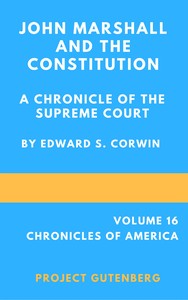
The source record for John Marshall and the Constitution, a Chronicle of the Supreme Court — Edition Insights measures this digital text at 55,188 words, 4 hr estimated reading time, and 9 detected text sections.
The text analysis averages about 24.8 words per sentence, while the detected sections provide another way to judge how the source is divided.
Project Gutenberg metadata also associates the work with “Constitutional history -- United States,” connecting these edition facts with the source record’s subject description.
Explore this collection
These alternatives are selected using recorded categories and estimated reading time.
About 284 minutes
Adventure Picaresque Fiction
65,244 recorded words. 44 minutes difference from this book's estimate.
View Gutenberg source #57764About 290 minutes
Adventure Picaresque Fiction
66,537 recorded words. 50 minutes difference from this book's estimate.
View Gutenberg source #36188About 164 minutes
Adventure Picaresque Fiction
37,631 recorded words. 76 minutes difference from this book's estimate.
View Gutenberg source #10401Search stored excerpts and compare books → Choose by your preferences →
Choices use stored catalog measurements. Estimates vary with reading speed. A shared category is a catalog label, not a claim that two books have the same argument or literary quality.
Search reads excerpt text stored with this catalog and links to its associated Gutenberg record. The connection is stored in the site database; this tool does not recheck that every excerpt is word-for-word identical to that external record. Excerpt search does not cover every chapter and does not verify historical publication dates.
Catalog snapshot checked: 2026-09-25. Coverage: 90 public books, 90 available source excerpts.
Calculated from edition completeness, EPUB availability, text structure and catalogue metadata. Not a user rating.
Total of 100 points, scaled to a 2.5-5.0 range. Editions with an empty description or a missing EPUB file are not scored.
Public-domain source text
The source text is kept in the dedicated reader, separate from this catalogue record and its commentary.
Corwin opens with an arresting analogy: the federal judiciary, he writes, resembles a medieval ecclesiastical hierarchy—'an army encamped on the soil of Christendom'—whose 'tremendous weapons' slay legislation. This comparison sets the tone for a study that treats John Marshall not merely as a jurist but as a constitutional architect whose intellectual battles mirrored those of Pope Hildebrand. The chronicle, part of the Chronicles of America series, focuses tightly on Marshall's nationalist jurisprudence, drawing extensively from his opinions in cases such as McCulloch v. Maryland and Dartmouth College v. Woodward.
Corwin’s opening chapter establishes a sustained metaphor: the federal judiciary is 'stamped with a certain resemblance to an ecclesiastical hierarchy.' He compares the Court’s structure—life tenure, appellate machinery, moral authority—to the Church’s discipline and reach. The 'Hildebrand of American constitutionalism' is Marshall, who fought for supremacy with 'intellectual weapons' just as the Pope did. This framing is not decorative; it shapes the book’s argument that Marshall’s project was to make the Court the authoritative voice of the Constitution, much as the Church claimed to speak for God. Corwin returns to this theme when discussing McCulloch, where Marshall declares the Constitution 'supreme law of the land' and insists that the government 'though limited in its powers, is supreme within the sphere of its action.' The analogy underscores the stakes: Marshall was not merely interpreting law but establishing a rival sovereignty.
Corwin devotes considerable attention to Marshall’s opinion in McCulloch v. Maryland, parsing its logic and language. He highlights Marshall’s response to Maryland’s narrow reading of the 'necessary and proper' clause: 'Such is the character of human language,' Marshall wrote, 'that no word conveys to the mind in all situations, one single definite idea.' Corwin shows how Marshall turned textual ambiguity into a weapon, arguing that the clause was meant to 'remove all doubts' about Congress’s incidental powers, not to restrict them. The Chief Justice’s famous dictum—'Let the end be legitimate, let it be within the scope of the Constitution, and all means which are appropriate… are constitutional'—is presented as a deliberate expansion of federal authority. Corwin notes that Marshall grounded this reasoning in the Constitution’s durability: it was 'intended to endure for ages to come and consequently to be adapted to the various crises of human affairs.'
A central thread in Corwin’s account is Marshall’s insistence that the Constitution emanates from the people, not the states. In McCulloch, Marshall rejected the argument 'that the people had already surrendered all their powers to the State Sovereignties,' asking rhetorically whether they might 'resume and modify the power granted to the government.' Corwin emphasizes Marshall’s conclusion: 'The Government of the Union, then, is emphatically… a government of the people. In form and in substance it emanates from them.' This populist foundation undercut state-sovereignty claims and justified federal supremacy. Corwin traces this logic across the book, showing how Marshall consistently located sovereignty in the national electorate. The chronicle thus presents Marshall’s nationalism as a democratic theory, not merely a legal doctrine—a move that made the Court the guardian of a unified popular will.
Corwin’s chronicle rewards readers who attend to its rhetorical architecture: the ecclesiastical metaphor, the close dissection of Marshall’s opinions, and the repeated emphasis on popular sovereignty. Rather than a dry legal history, it offers a portrait of a judge who understood that constitutional meaning is forged in language and institutional struggle. Those approaching the book should watch how Corwin uses Marshall’s own words to build his case, and note where the analogy to Hildebrand strains—a reminder that the chronicle is itself an argument, not a neutral record.
Reading about Marshall shaping law from ambiguity reminded me of leafing through Non-Criminal Prisons English Debtor's Prisons and Prisons of War; French War Prisons; American War Prisons with References to Those of Other Lands — Reading Notes last winter. Both books make me feel how institutions quietly become what people insist they are—walls, like clauses, hold only the weight we give them.
Save your reaction, strongest insight, and memorable passage.