About 718 minutes
Studies in history and jurisprudence, volume 2 (of 2) — Edition Insights
Science Fiction Utopias
165,045 recorded words. 37 minutes difference from this book's estimate.
View Gutenberg source #78301
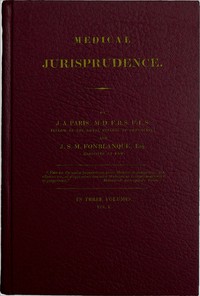
For Medical Jurisprudence, Volume 1 (of 3) — Key Ideas to Explore, the stored edition analysis reports 156,543 words, 11 hr 21 min estimated reading time, and 53 detected text sections.
The text analysis averages about 30.3 words per sentence, while the detected sections provide another way to judge how the source is divided.
Project Gutenberg metadata also associates the work with “Medical laws and legislation -- Great Britain,” connecting these edition facts with the source record’s subject description.
Explore this collection
These alternatives are selected using recorded categories and estimated reading time.
About 718 minutes
Science Fiction Utopias
165,045 recorded words. 37 minutes difference from this book's estimate.
View Gutenberg source #78301About 628 minutes
Science Fiction Utopias
144,373 recorded words. 53 minutes difference from this book's estimate.
View Gutenberg source #46746About 612 minutes
Science Fiction Utopias
140,634 recorded words. 69 minutes difference from this book's estimate.
View Gutenberg source #63830Search stored excerpts and compare books → Choose by your preferences →
Choices use stored catalog measurements. Estimates vary with reading speed. A shared category is a catalog label, not a claim that two books have the same argument or literary quality.
Search reads excerpt text stored with this catalog and links to its associated Gutenberg record. The connection is stored in the site database; this tool does not recheck that every excerpt is word-for-word identical to that external record. Excerpt search does not cover every chapter and does not verify historical publication dates.
Catalog snapshot checked: 2026-09-25. Coverage: 90 public books, 90 available source excerpts.
Calculated from edition completeness, EPUB availability, text structure and catalogue metadata. Not a user rating.
Total of 100 points, scaled to a 2.5-5.0 range. Editions with an empty description or a missing EPUB file are not scored.
Public-domain source text
The source text is kept in the dedicated reader, separate from this catalogue record and its commentary.
Medical Jurisprudence opens with a dedication to the Lord High Chancellor and the President of the Royal College of Physicians, signaling its dual audience of legal and medical professionals. The authors, J. A. Paris (a physician) and J. S. M. Fonblanque (a barrister), aim to bridge two fields that, as the epigraph from Hebenstreit puts it, are joined by a kind of marriage. The work is structured in two parts: the first surveys the powers and privileges of medical institutions—the College of Physicians, the College of Surgeons, the Society of Apothecaries—and public health regulations; the second addresses medical evidence, marriage, divorce, and physiological questions such as puberty, impotence, and sterility.
The first part of the volume catalogues the legal powers of medical bodies in early 19th-century Britain. The College of Physicians, the College of Surgeons, and the Society of Apothecaries each receive detailed treatment, including their privileges, exemptions, and liabilities. The authors also examine actions by and against medical practitioners, midwifery, and public health measures like quarantine and lazarettos. A recurring tension is the boundary between professional authority and legal accountability: for instance, the text asks whether epidemic fevers are contagious and whether filth can generate contagion—questions that have both medical and legal implications for public health policy.
The second part opens with an introduction to medical evidence, then moves to marriage and divorce, where physiological knowledge becomes legally decisive. The authors discuss ages of puberty, impotence (organic, functional, and moral causes), sterility, and legitimacy of children. They also address supposititious children, monsters, and hermaphrodites. The tone is clinical, but the legal stakes are high: a woman’s unconsciousness during delivery, for example, could determine paternity or inheritance. The text relies on cited authorities like Dr. Merriman, whose opinions on inducing premature labour are presented with cautionary notes against hasty instrumental intervention.
A detailed discussion of instrumental delivery reveals the authors’ careful weighing of risk. They classify interventions into three types: those that injure neither mother nor child (forceps, lever), those that mutilate the child (perforator, crotchet), and those that wound the mother (Cæsarean and Sigaultian operations). The Cæsarean section is traced from its alleged origin with Julius Cæsar through medieval and Renaissance authors. The authors note that in Britain the operation has been generally fatal, citing an extraordinary case in Ireland. They emphasize that a practitioner should not resort to instruments hastily, and that consultation with another respectable practitioner is advisable before inducing premature labour.
Readers approaching this volume should note its dual authorship: Paris provides medical expertise, Fonblanque legal precision. The text is dense with references to statutes, case law, and medical authorities, often in Latin. The table of contents is a reliable guide to the work’s structure, but the arguments unfold through a series of questions and answers, reflecting a forensic method. This is not a narrative but a reference work for practitioners navigating the fraught border between healing and judging.
Leafing through the 1823 treatise on medical jurisprudence, I remembered sitting with my grandfather’s old law books, feeling the weight of decisions made before I existed. There’s a quiet awe in touching those pages, a sense of lives argued over. That same solemn hush came over me later with The Constitution of the United States of America: Analysis and Interpretation Annotations of Cases Decided by the Supreme Court of the United States to June 30, 1952 — Edition Insights, where every annotation felt like a whispered precedent.
Capture what you thought, learned, and would like to remember.