About 317 minutes
By Advice of Counsel — A Closer Reading
Science Fiction Utopias
72,690 recorded words. 101 minutes difference from this book's estimate.
View Gutenberg source #11987
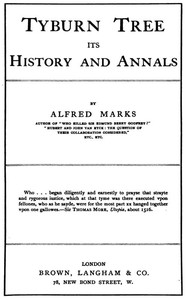
This digital edition of Tyburn Tree: Its History and Annals — Themes and Context is described by source-level measurements including 95,976 words, 6 hr 58 min estimated reading time, and 12 detected text sections.
The text analysis averages about 22.5 words per sentence, while the detected sections provide another way to judge how the source is divided.
Project Gutenberg metadata also associates the work with “Crime -- Great Britain,” connecting these edition facts with the source record’s subject description.
Explore this collection
These alternatives are selected using recorded categories and estimated reading time.
About 317 minutes
Science Fiction Utopias
72,690 recorded words. 101 minutes difference from this book's estimate.
View Gutenberg source #11987About 531 minutes
Science Fiction Utopias
122,111 recorded words. 113 minutes difference from this book's estimate.
View Gutenberg source #31298About 281 minutes
Science Fiction Utopias
64,510 recorded words. 137 minutes difference from this book's estimate.
View Gutenberg source #44552Search stored excerpts and compare books → Choose by your preferences →
Choices use stored catalog measurements. Estimates vary with reading speed. A shared category is a catalog label, not a claim that two books have the same argument or literary quality.
Search reads excerpt text stored with this catalog and links to its associated Gutenberg record. The connection is stored in the site database; this tool does not recheck that every excerpt is word-for-word identical to that external record. Excerpt search does not cover every chapter and does not verify historical publication dates.
Catalog snapshot checked: 2026-09-25. Coverage: 90 public books, 90 available source excerpts.
Calculated from edition completeness, EPUB availability, text structure and catalogue metadata. Not a user rating.
Total of 100 points, scaled to a 2.5-5.0 range. Editions with an empty description or a missing EPUB file are not scored.
Public-domain source text
The source text is kept in the dedicated reader, separate from this catalogue record and its commentary.
Alfred Marks opens Tyburn Tree: Its History and Annals with a striking epigraph from Sir Thomas More's Utopia, noting that felons were 'for the most part xx hanged together upon one gallowes.' This image of mass execution sets the tone for a work that moves between legal records, execution broadsides, and social commentary. Marks draws on sources ranging from Chief Justice Fortescue's 15th-century comparisons of English and French hanging rates to Mrs. Fry's 1818 prison observations, creating a mosaic of voices that spans centuries.
The book's central structure is a chronological annals of executions at Tyburn, drawn from sources like Stow's Survey of London, the Gentleman's Magazine, and state papers. Marks presents these entries with minimal editorializing, allowing the raw data to accumulate: John Kelly hanged for stealing sixpence and a farthing in 1783; Roger Ashton executed in 1592 for obtaining a papal dispensation to marry his cousin. The entries vary in detail—some give only names and crimes, others include the condemned's last words or the method of execution. This catalog-like approach creates a cumulative effect, emphasizing the routine nature of public death.
Marks repeatedly draws attention to the physical journey from Newgate to Tyburn. The condemned were 'conuayd by water from Westminster to the Bishoppe of Winchesters staires in Southwarke, from thence to the K. bench, there laid on hurdles, and conuayd by the Sheriffes of London ouer the bridge, vp to Leaden hall, and so to Tyborne.' This procession—through streets, over bridges, past landmarks—turned execution into a public spectacle. Marks includes illustrations of the gibbet on Kennington Common and drawings of prisoners on hurdles, reinforcing the spatial dimension of punishment. The route itself becomes a character in the narrative.
Interspersed with the annals are moments of critical reflection. Marks quotes Lingard's skepticism about confessions 'made in the Tower, and probably on the rack,' and notes the political rivalries behind the execution of Roderigo Lopez, Queen Elizabeth's physician. He includes Mrs. Fry's observation that prisoners considered their own crimes 'as nothing when compared with the crimes of Government towards themselves.' These voices complicate the official record, suggesting that the gallows served not only justice but also power struggles and religious persecution. Marks does not resolve these tensions but lets them stand alongside the factual entries.
In his preface, Marks acknowledges the 'many aspects, some noble, some squalid, some pathetic, some revolting' of Tyburn's story, and defends his attention to horror by citing Lipsius's treatise De Cruce. Yet the book's purpose extends beyond antiquarianism. Marks notes that 'the general tendency is all towards extending the power of governments,' a remark that frames the historical material as relevant to contemporary debates about state authority. The excerpts show a work that oscillates between compiling facts and questioning the systems that produced them, leaving readers to weigh the evidence themselves.
Marks's method—juxtaposing official records with critical commentary—invites readers to consider how narratives of crime and punishment are constructed. The book does not argue a single thesis but presents a collection of voices, from judges to prisoners, from chroniclers to reformers. Readers attentive to the gaps between these perspectives will find the richest engagement with Tyburn's complex legacy.
That rainy afternoon, I kept returning to Marks’s account of the crowds at Tyburn—how the spectacle of justice became something people carried home. It made me think of quieter verdicts, ones rendered privately, in rooms. Later, almost by accident, I found By Advice of Counsel — A Closer Reading, which lingers on those unseen deliberations. The rain never stopped; the two books seemed to speak to each other.
A brief reflection can help important ideas stay with you longer.