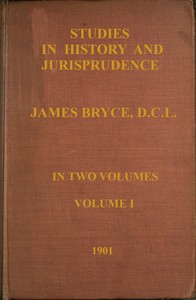
Studies in history and jurisprudence, volume 1 (of 2) — Context and Discussion

(0 User reviews)   681
Bryce, James Bryce, Viscount, 1838-1922 Project Gutenberg 2026 Not confirmed
Constitutional law; Comparative law; Jurisprudence; Roman law -- History; Law -- Great Britain -- History; Constitutional history Readers of public-domain and historical texts
Project Gutenberg digital edition en

Edition facts

Words 163,583
Reading time 712 min
Text sections 23

The catalog record for Studies in history and jurisprudence, volume 1 (of 2) — Context and Discussion provides practical reading context through 163,583 words, 11 hr 52 min estimated reading time, and 23 detected text sections.

The text analysis averages about 29.2 words per sentence, while the detected sections provide another way to judge how the source is divided.

Project Gutenberg metadata also associates the work with “Constitutional law,” connecting these edition facts with the source record’s subject description.

Explore this collection

Compare your next read

These alternatives are selected using recorded categories and estimated reading time.

Search stored excerpts and compare books → Choose by your preferences →

How these choices and excerpts are prepared

Choices use stored catalog measurements. Estimates vary with reading speed. A shared category is a catalog label, not a claim that two books have the same argument or literary quality.

Search reads excerpt text stored with this catalog and links to its associated Gutenberg record. The connection is stored in the site database; this tool does not recheck that every excerpt is word-for-word identical to that external record. Excerpt search does not cover every chapter and does not verify historical publication dates.

Catalog snapshot checked: 2026-09-25. Coverage: 90 public books, 90 available source excerpts.

James Bryce's comparative study examines Roman and English legal history through essays on empires, constitutions, and law. The excerpts show a focus on centrifugal forces in states, using Ireland, Norway-Sweden, Poland, and the American South as case studies, with constitutional remedies discussed.
Share
Editorial Edition Score 4.9/5

Calculated from edition completeness, EPUB availability, text structure and catalogue metadata. Not a user rating.

How this score is calculated
  • Description quality20 pts
  • Title & short description10 pts
  • Source metadata20 pts
  • Text length15 pts
  • Chapters / structure15 pts
  • EPUB file integrity20 pts

Total of 100 points, scaled to a 2.5-5.0 range. Editions with an empty description or a missing EPUB file are not scored.

Edition quality

Public-domain source text

Read the source text

The source text is kept in the dedicated reader, separate from this catalogue record and its commentary.

James Bryce opens this collection by noting that the essays were composed over many years and share a common thread: comparing the history and law of Rome with those of England. The preface signals a comparative method applied to empires, legal systems, constitutions, and legislation. The excerpts, however, reveal a narrower focus in practice: a detailed analysis of centrifugal forces within states, using Ireland, Norway-Sweden, Poland, and the American South as examples. Bryce examines the sources of disaffection—religious, economic, national—and then asks what constitutional arrangements can reduce such disruptive tendencies. This editorial note examines how the catalog subjects align with what the excerpts actually show.

Centrifugal Forces and Constitutional Remedies

The excerpts devote sustained attention to the causes of secessionist or autonomist movements. Bryce enumerates factors in Ireland: diversity of faith, economic grievances, landlord exactions, and an incompatibility of character between Celt and Teuton. For Norway-Sweden, he notes democratic differences and national pride. Poland’s case turns on memory of independence and religious difference. The American South is treated as a puzzle: no religious or revengeful factor, but a conviction that slavery was threatened, coupled with state governments providing a legal basis for secession. This comparative survey is not merely descriptive; Bryce pivots to ask what constitutions can do to reduce such tendencies, advocating peaceful means over coercion. The catalog subjects list constitutional law and comparative law, and these excerpts deliver precisely that—a comparative constitutional analysis of disunity.

The Roman and British Empires as Framing Devices

The preface announces that many essays compare Rome and England, yet the excerpts do not develop that comparison in detail. The first essay is titled “Roman and British Empires,” but the provided text does not include its substance. Instead, the excerpts jump to a later discussion of modern secessionist movements. This gap between the catalog promise and the excerpt evidence is notable. The catalog also lists Roman law history and Great Britain legal history, but the excerpts show Bryce applying a comparative method to contemporary politics rather than to ancient legal systems. Readers should be aware that the volume likely contains the promised Roman-English comparisons in other essays, but the excerpts here emphasize modern constitutional crises.

Bryce’s Argumentative Structure and Voice

Bryce’s prose is analytical and measured, avoiding polemic. He presents multiple causes for each case, weighing them with phrases like “easily explicable” and “much less evident.” He uses conditional constructions: “had this force acted upon the whole nation … it would have before now prevailed.” His voice is that of a scholar addressing a learned audience, with references to historical events (Congress of Vienna, 1814) and legal concepts (State Governments, constitutional guarantees). The excerpts show a preference for enumerating factors in lists, then drawing cautious conclusions. This structure—diagnosis followed by constitutional prescription—is consistent with the catalog subject of jurisprudence, understood as the philosophy of law. The writing is dense but clear, with occasional rhetorical questions (“What then can the framing … of a Constitution do?”).

Readers approaching this volume for its Roman law content should note that the excerpts emphasize modern comparative constitutionalism. The catalog subjects are accurate but broad; the excerpts narrow to a specific theme of centrifugal forces. Bryce’s method is comparative and historical, but the evidence here is contemporary (late 19th-century) politics. The full volume likely contains the promised Roman-English parallels, but this excerpt suggests a work more engaged with current affairs than the catalog might imply.

I keep thinking about how Bryce watched old unions fray—Ireland, Poland, the American South—and how quietly he traced each crack back to its legal seams. It reminded me of that strange little executor’s handbook, De Mortuis Nil Nisi Bona Being a Series of Problems in Executorship Law and Accounts — Story, Setting & Ideas, where every estate problem is really a buried relationship. Both books let you sit with what lingers after the formalities end.

There are no reviews for this eBook.

0
0 out of 5 (0 User reviews )

Add a Review

Your Rating *
There are no comments for this eBook.

Reader reflection

Before you leave, reflect on the book

Use these questions to collect your thoughts before moving on.

Your progress 0 / 10
1

What is your current status with this title?

2

How much did you enjoy the reading experience?

3

How likely are you to recommend this book?

4

How easy was the book to follow?

Related eBooks