Celebrated naval and military trials — A Closer Reading

(0 User reviews)   1540
Burke, Peter, 1811-1881 Project Gutenberg 2025 Not confirmed
Courts-martial and courts of inquiry -- Great Britain; Trials (Military offenses) -- Great Britain; Trials (Naval offenses) -- Great Britain Readers of public-domain and historical texts
Project Gutenberg digital edition en

Edition facts

Words 114,085
Reading time 497 min
Text sections 18

The source record for Celebrated naval and military trials — A Closer Reading measures this digital text at 114,085 words, 8 hr 17 min estimated reading time, and 18 detected text sections.

The text analysis averages about 27.9 words per sentence, while the detected sections provide another way to judge how the source is divided.

Project Gutenberg metadata also associates the work with “Courts-martial and courts of inquiry -- Great Britain,” connecting these edition facts with the source record’s subject description.

Explore this collection

Compare your next read

These alternatives are selected using recorded categories and estimated reading time.

Search stored excerpts and compare books → Choose by your preferences →

How these choices and excerpts are prepared

Choices use stored catalog measurements. Estimates vary with reading speed. A shared category is a catalog label, not a claim that two books have the same argument or literary quality.

Search reads excerpt text stored with this catalog and links to its associated Gutenberg record. The connection is stored in the site database; this tool does not recheck that every excerpt is word-for-word identical to that external record. Excerpt search does not cover every chapter and does not verify historical publication dates.

Catalog snapshot checked: 2026-09-25. Coverage: 90 public books, 90 available source excerpts.

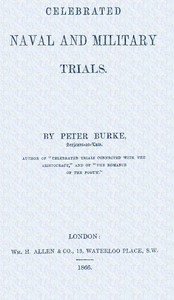
Peter Burke's 1866 collection of thirteen court-martial and court of inquiry accounts, from Admiral Benbow's treacherous captains to the Mutiny of the Bounty, focusing on the tensions between authority, duty, and survival in British naval and military history.
Share
Editorial Edition Score 4.8/5

Calculated from edition completeness, EPUB availability, text structure and catalogue metadata. Not a user rating.

How this score is calculated
  • Description quality20 pts
  • Title & short description10 pts
  • Source metadata20 pts
  • Text length15 pts
  • Chapters / structure15 pts
  • EPUB file integrity20 pts

Total of 100 points, scaled to a 2.5-5.0 range. Editions with an empty description or a missing EPUB file are not scored.

Edition quality

Public-domain source text

Read the source text

The source text is kept in the dedicated reader, separate from this catalogue record and its commentary.

Peter Burke, a Serjeant-at-Law, assembles thirteen accounts of courts-martial and courts of inquiry spanning the late seventeenth to early nineteenth centuries. The volume opens with Admiral Benbow, whose popular renown as a "rough and real British seaman" contrasts sharply with the treachery of his captains. Burke draws on trial records, published narratives, and his own legal expertise to reconstruct each case, often highlighting the gap between public perception and judicial outcome.

The excerpts reveal a consistent pattern: commanders facing mutiny, dereliction, or ambiguous orders, while subordinates navigate loyalty and self-preservation. Burke's framing—dedicating the work to a friend with "congenial tastes"—suggests an intended readership already interested in legal and military history, not a general audience.

The Admiral and His Captains: Authority Under Duress

The Benbow case establishes a recurring tension: the popular hero versus the legal record. Burke notes that Benbow was "the sailors' idol" and his likeness adorned inn signs, yet the trial of his captains reveals a more complex reality. The captains' failure to support Benbow in action led to a court-martial, but Burke does not simply condemn them; he presents the evidence, allowing readers to weigh the pressures of command. Similarly, the trial of Admiral Byng—executed for failing to relieve Minorca—raises questions about whether the punishment fit the circumstances. Burke's legal background is evident in his careful presentation of charges and defenses, avoiding melodrama while letting the procedural details speak.

Mutiny and Survival: The Bounty and the Nore

The account of the Bounty mutiny focuses not on Fletcher Christian but on Captain Bligh's extraordinary open-boat voyage. Burke quotes Bligh's own narrative, describing the crew as "spectres" with "ghastly countenances" after 46 days on limited rations. The contrast between Bligh's indomitable will and the mutineers' rebellion is left implicit; Burke instead emphasizes the physical ordeal and the Dutch governor's humane reception at Timor. The Mutiny at the Nore, by contrast, involves organized insubordination within the fleet, with demands for better pay and conditions. Burke treats both as legal and human dramas, not as simple tales of villainy or heroism.

Civilians in the Dock: Espionage and Escape

Not all trials involve uniformed defendants. "The Dockyard Incendiary, Jack the Painter" deals with arson at Portsmouth, while the case of General Sir Robert Wilson concerns the escape of the French prisoner Lavallette. These entries broaden the scope beyond the quarterdeck, showing how military law intersected with civilian life and international politics. Burke's inclusion of such cases suggests that his definition of "naval and military trials" extends to any proceeding where the interests of the armed forces and the state collide. The variety of charges—from piracy (Captain Kidd) to treason (Colonel Despard)—demonstrates the range of offenses that could bring a person before a court-martial.

Readers approaching this collection should expect legal documents as much as narratives. Burke often reproduces testimony and official correspondence, slowing the pace but rewarding attention to detail. The trials are not arranged chronologically but thematically, with earlier cases establishing patterns that later ones complicate. Those interested in the gap between public memory and judicial process will find ample material, particularly in the Benbow and Byng chapters. A willingness to engage with eighteenth-century legal language and procedure will enhance the experience.

Reading these court-martial accounts, I kept thinking how survival bends a person’s sense of duty. It reminded me of the quiet horror in Cincinnati's "Old Cunny": A Notorious Purveyor of Human Flesh — Text and Context, where authority and desperation blur into something almost unspeakable. Both books left me staring out the window longer than I expected.

There are no reviews for this eBook.

0
0 out of 5 (0 User reviews )

Add a Review

Your Rating *
There are no comments for this eBook.

Reader reflection

What was your reading experience?

Capture what you thought, learned, and would like to remember.

Your progress 0 / 10
1

Which reading stage best describes you?

2

How much did you enjoy the reading experience?

3

Would you pass this book on to a friend?

4

How much effort did this book require?

Related eBooks