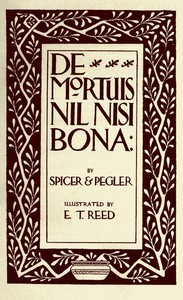
De Mortuis Nil Nisi Bona Being a Series of Problems in Executorship Law and Accounts — Story, Setting & Ideas

(0 User reviews)   1708
Spicer, Ernest Evan, Pegler, Ernest Charles, Ranking, Devey Fearon de l'Hoste, 1848?-1931 [Author of introduction, etc.], Reed, Edward Tennyson, 1860-1933 [Illustrator] Project Gutenberg 2013 Not confirmed
Executors and administrators -- Great Britain; Decedents' estates -- Great Britain Readers of public-domain and historical texts
Project Gutenberg digital edition en

Edition facts

Words 17,638
Reading time 77 min
Text sections 4

This digital edition of De Mortuis Nil Nisi Bona Being a Series of Problems in Executorship Law and Accounts — Story, Setting & Ideas is described by source-level measurements including 17,638 words, 1 hr 17 min estimated reading time, and 4 detected text sections.

The text analysis averages about 16.2 words per sentence, while the detected sections provide another way to judge how the source is divided.

Project Gutenberg metadata also associates the work with “Executors and administrators -- Great Britain,” connecting these edition facts with the source record’s subject description.

Explore this collection

Compare your next read

These alternatives are selected using recorded categories and estimated reading time.

Search stored excerpts and compare books → Choose by your preferences →

How these choices and excerpts are prepared

Choices use stored catalog measurements. Estimates vary with reading speed. A shared category is a catalog label, not a claim that two books have the same argument or literary quality.

Search reads excerpt text stored with this catalog and links to its associated Gutenberg record. The connection is stored in the site database; this tool does not recheck that every excerpt is word-for-word identical to that external record. Excerpt search does not cover every chapter and does not verify historical publication dates.

Catalog snapshot checked: 2026-09-25. Coverage: 90 public books, 90 available source excerpts.

A satirical problem book blending executorship law with absurd fictional scenarios, illustrated by E. T. Reed, where legal puzzles are framed as comic narratives.
Share
Editorial Edition Score 4.5/5

Calculated from edition completeness, EPUB availability, text structure and catalogue metadata. Not a user rating.

How this score is calculated
  • Description quality20 pts
  • Title & short description10 pts
  • Source metadata20 pts
  • Text length15 pts
  • Chapters / structure15 pts
  • EPUB file integrity20 pts

Total of 100 points, scaled to a 2.5-5.0 range. Editions with an empty description or a missing EPUB file are not scored.

Edition quality

Public-domain source text

Read the source text

The source text is kept in the dedicated reader, separate from this catalogue record and its commentary.

This work presents a series of executorship problems, each embedded in a fictional scenario that lampoons the solemnity of legal instruction. The authors, both chartered accountants, use invented testators—such as a colonel who dies on a voyage from Brazil—to frame calculations of estate division, legacy duties, and executor salaries. The problems are interspersed with E. T. Reed's illustrations, which visually underscore the absurdity of the situations. The book's structure alternates between dry legal exposition and comic vignettes, creating a distinctive rhythm that mirrors the dual nature of the subject: precise accounting rules applied to human folly.

A Structure of Alternating Modes

The book moves between two distinct textual modes: the formal language of legal problems and the informal, often farcical, narrative that frames them. For instance, Problem No. 26 opens with the death of Sir John Hopper on St. Valentine's Day, then lists his estate in the dry cadence of a property advertisement: “Delightful situation, 4 Reception Rooms, 8 Bed and Dressing Rooms.” This juxtaposition recurs throughout. The preface acknowledges the method: “our object is to instruct,” but the method is to embed instruction within comedy. The reader is never allowed to settle into a single tone; the shift from legal precision to social satire is abrupt and deliberate.

Recurring Images of Death and Inheritance

Death is treated not as a solemn event but as a trigger for arithmetic. The testators die on specific dates—the Feast of St. Valentine, the voyage home from Brazil—and their estates are itemized with clinical detail. The recurring image of the will as a document that sets off a chain of calculations is central. In Problem No. 27, Colonel Filbert's will creates a salary scheme for executors that is itself a mathematical puzzle. The illustrations by E. T. Reed often depict the deceased in humorous poses, reinforcing the idea that death is merely the starting point for a problem. The phrase “died intestate” appears repeatedly, signaling the absence of a will and the consequent application of default rules.

Movement Between Scenes and Settings

The problems shift rapidly between domestic and commercial settings. A breakfast invitation from a widow (Problem No. 25) gives way to a freehold estate in Canterbury, then to a bank deposit scheme. The settings are not described in depth but are sketched with enough detail to ground the legal scenario: a solicitor's office, a country house, a bank. The movement is not geographical but situational—each problem creates a new microcosm of inheritance. The characters are types: the spinster aunt, the bachelor uncle, the scheming clerk. The settings serve as backdrops for the real action: the calculation of shares, the writing of cash accounts.

The Role of the Illustrations

E. T. Reed's illustrations are integral to the book's effect. They are not merely decorative but often provide visual punchlines to the legal scenarios. For example, one illustration shows a woman with a pierced heart, captioned “Miss Tulip's heart was forthwith pierced,” accompanying a problem about a fortune inherited by a Miss Rose Tulip. The drawings exaggerate facial expressions and postures, turning the legal actors into caricatures. The illustrations also break up the text, creating visual pauses that mirror the structural alternation between problem and narrative. They remind the reader that this is a work of entertainment as much as instruction.

Readers approaching this book should expect to encounter legal problems that are both genuine and parodic. The authors assume familiarity with basic executorship law, but the scenarios are designed to amuse as much as to instruct. The illustrations and narrative framing reward attention to detail; the humor often lies in the gap between the gravity of the subject and the absurdity of the situations. This is a book to be read with a calculator and a sense of irony.

There’s a particular absurd kindness in old law books—this one turning executorship into satire, pairing every grim duty with a cartoon. It put me in mind of that other quiet volume on debtor’s prisons, where Non-Criminal Prisons English Debtor's Prisons and Prisons of War; French War Prisons; American War Prisons with References to Those of Other Lands — Reading Notes holds its own bleak humor, all stone walls and vanished promises, and I felt the same fond ache.

There are no reviews for this eBook.

0
0 out of 5 (0 User reviews )

Add a Review

Your Rating *
There are no comments for this eBook.

Reader reflection

What did you think of this book?

Answer a few questions and save a private reflection on this device.

Your progress 0 / 10
1

Have you finished this book?

2

What was your overall reaction to the book?

3

Is this a title you would suggest to others?

4

Did the language feel accessible?

Related eBooks