About 681 minutes
Medical Jurisprudence, Volume 1 (of 3) — Key Ideas to Explore
Science Fiction Utopias
156,543 recorded words. 37 minutes difference from this book's estimate.
View Gutenberg source #63241
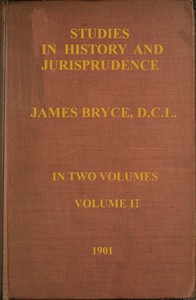
Studies in history and jurisprudence, volume 2 (of 2) — Edition Insights can be approached with a clearer sense of reading commitment from its source measurements: 165,045 words, 11 hr 58 min estimated reading time, and 25 detected text sections.
The text analysis averages about 27.0 words per sentence, while the detected sections provide another way to judge how the source is divided.
Project Gutenberg metadata also associates the work with “Constitutional law,” connecting these edition facts with the source record’s subject description.
Explore this collection
These alternatives are selected using recorded categories and estimated reading time.
About 681 minutes
Science Fiction Utopias
156,543 recorded words. 37 minutes difference from this book's estimate.
View Gutenberg source #63241About 791 minutes
Science Fiction Utopias
181,812 recorded words. 73 minutes difference from this book's estimate.
View Gutenberg source #74804About 797 minutes
Science Fiction Utopias
183,266 recorded words. 79 minutes difference from this book's estimate.
View Gutenberg source #40445Search stored excerpts and compare books → Choose by your preferences →
Choices use stored catalog measurements. Estimates vary with reading speed. A shared category is a catalog label, not a claim that two books have the same argument or literary quality.
Search reads excerpt text stored with this catalog and links to its associated Gutenberg record. The connection is stored in the site database; this tool does not recheck that every excerpt is word-for-word identical to that external record. Excerpt search does not cover every chapter and does not verify historical publication dates.
Catalog snapshot checked: 2026-09-25. Coverage: 90 public books, 90 available source excerpts.
Calculated from edition completeness, EPUB availability, text structure and catalogue metadata. Not a user rating.
Total of 100 points, scaled to a 2.5-5.0 range. Editions with an empty description or a missing EPUB file are not scored.
Public-domain source text
The source text is kept in the dedicated reader, separate from this catalogue record and its commentary.
Bryce opens by comparing the Roman Empire and the British Empire in India, noting that both powers created a 'sort of unity of mankind' through conquest and administration. He highlights how England's role in ruling new territories parallels Rome's earlier effort to unify diverse peoples. The essay immediately establishes a comparative framework, examining conditions favoring conquest, military character, road building, and internal security.
In the excerpt on Roman legislative assemblies, Bryce describes a system where bodies are 'composed of minor bodies' and decisions are made by 'double voting.' Each individual votes in a group—curia, centuria, or tribus—and the majority of groups determines the outcome, not the majority of individuals. This means a proposition can pass with a majority of group votes even if individual votes are against it. Bryce notes this method survives in Scottish university rectorial elections and in U.S. presidential elections when the House votes by states. He emphasizes that these assemblies could be convoked only by a magistrate, had no discussion, and voted once with finality. The system risked either blocking legislation or making it hasty, but Bryce observes that direct legislation was limited because private law improvement was left to the Praetor and jurists, and administrative law was minimal.
Bryce draws parallels between Roman and British Indian administration, noting both were despotic systems that allowed some self-government to subjects. He discusses variations in provincial administration, revenue and taxation, and the employment of native subjects in civil and military posts. The comparison extends to military strength, natural frontiers, and the building of roads and railways. Bryce emphasizes that both empires succeeded in maintaining internal order and security, but he does not claim one was superior; instead, he presents structural similarities and differences based on historical evidence.
Bryce explains that under the Roman Republic, the improvement of ordinary private law was 'for the most part left to the Praetor and the jurists.' This delegation meant that the legislative assemblies did not need to handle complex legal reforms. The Praetor's edicts and juristic interpretation shaped Roman law incrementally, avoiding the pitfalls of direct popular legislation. Bryce contrasts this with modern systems where administrative law is extensive, noting that in Rome, magistrates and the Senate had wide discretion, and local communities managed their own affairs. This observation underscores the flexibility of Roman legal development outside the assembly system.
Bryce analyzes the Roman system of checks, noting that assemblies could be stopped by another magistrate and that no discussion took place—only voting on propositions. He points out that this machinery seemed 'calculated either to check legislation by throwing obstacles in its way, or else to make legislation hasty and imprudent.' However, he tempers this by noting that not much direct legislation was needed. The excerpt also touches on the U.S. Constitution's method of electing a president when no candidate has a majority, showing Bryce's comparative approach across historical and modern constitutions.
Bryce's method is to ground broad comparisons in specific institutional details—voting procedures, administrative practices, and legal delegation. Readers should attend to how he uses concrete examples (Scottish university elections, U.S. presidential votes) to illuminate ancient practices. The essays reward careful reading of his footnotes and cross-references, which often contain further evidence. Approach this volume as a series of linked investigations rather than a single argument.
The way Bryce lets systems reveal their own weight—an empire's reach, a law's slow groundwork—stayed with me for weeks, that quiet hum of structure. Your 1921 Ohio mining text might carry a gentler echo of it, the same patient attention to how rules shape land and lives. Mining Laws of Ohio, 1921 — Key Ideas to Explore feels like a small, honest stone beside that vast cathedral.
A brief reflection can help important ideas stay with you longer.