
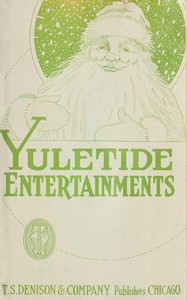
Yuletide entertainments : Christmas recitations, monologues, drills, tableaux,…
Forget everything you know about modern holiday entertainment. 'Yuletide Entertainments,' published in 1897 by Ellen M. Willard, isn't a story with a beginning, middle, and end. Instead, it's a practical manual, a treasure chest of ideas for creating a Christmas party in the late 1800s. The book is organized like a party planner's checklist, filled with ready-to-use material.
The Story
There's no traditional plot. The 'story' is the evening you're instructed to build. The book provides short recitations—often sentimental or moral poems—for children to memorize and deliver. There are dramatic monologues for older participants. The 'drills' are fascinating: detailed instructions for groups (often children) to perform synchronized movements with flags, wands, or hoops, creating a kind of simple, human kaleidoscope. Most intriguing are the 'tableaux vivants.' These are scripts for staging frozen scenes, usually depicting classic Christmas moments or allegorical ideas like 'Peace' or 'Charity,' with specific notes on costumes, poses, and lighting. The book itself is the blueprint for a communal creative experience.
Why You Should Read It
Reading this feels like discovering a secret recipe for joy from another time. The charm is in its earnestness and simplicity. The suggested entertainments are wholesome, community-focused, and require participation. It highlights how holiday fun was once active and homemade. You can almost hear the rustle of dresses, the giggles of children practicing, and the applause of a captivated parlor audience. Some pieces are sweetly sentimental by today's standards, but that's part of the appeal. It’s a direct line to the holiday spirit of the Victorian era, reminding us that connection and shared effort were the heart of celebration long before electric lights and streaming specials.
Final Verdict
This book is a niche gem, but a brilliant one for the right reader. It's perfect for history buffs, Christmas tradition enthusiasts, and community theater lovers. If you're a parent or teacher looking for a unique, old-fashioned activity for a holiday pageant, you might find real gold here. It's not a page-turner in the usual sense, but as a cultural artifact, it's utterly captivating. Approach it as a museum visit for your imagination, and you'll be delighted by the creativity of a Christmas past.
This is a copyright-free edition. You are welcome to share this with anyone.
Elizabeth Thomas
10 months agoFrom a researcher's perspective, the attention to detail regarding the core terminology is flawless. I'm glad I chose this over the other alternatives.
Matthew Anderson
7 months agoThought-provoking and well-organized content.
Paul Taylor
3 months agoI've gone through the entire material twice now, and the objective evaluation of the pros and cons is very refreshing. It definitely lives up to the reputation of the publisher.
William Thompson
3 weeks agoGiven the current trends in this field, it addresses the common misconceptions in a very professional manner. Thanks for making such a high-quality version available.
Thomas Anderson
7 months agoExceptional clarity on a very complex subject.