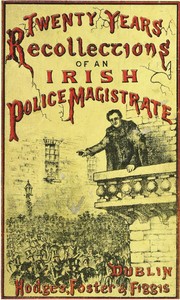
Twenty Years' Recollections of an Irish Police Magistrate — Edition Insights

(0 User reviews)   799
Porter, Frank Thorpe, 1801-1882 Project Gutenberg 2017 Not confirmed
Ireland -- Social life and customs; Porter, Frank Thorpe, 1801-1882; Crime -- Ireland; Criminals -- Ireland Readers of public-domain and historical texts
Project Gutenberg digital edition en

Edition facts

Words 146,091
Reading time 636 min
Text sections 16

This digital edition of Twenty Years' Recollections of an Irish Police Magistrate — Edition Insights is described by source-level measurements including 146,091 words, 10 hr 36 min estimated reading time, and 16 detected text sections.

The text analysis averages about 25.5 words per sentence, while the detected sections provide another way to judge how the source is divided.

Project Gutenberg metadata also associates the work with “Ireland -- Social life and customs,” connecting these edition facts with the source record’s subject description.

Explore this collection

Compare your next read

These alternatives are selected using recorded categories and estimated reading time.

Search stored excerpts and compare books → Choose by your preferences →

How these choices and excerpts are prepared

Choices use stored catalog measurements. Estimates vary with reading speed. A shared category is a catalog label, not a claim that two books have the same argument or literary quality.

Search reads excerpt text stored with this catalog and links to its associated Gutenberg record. The connection is stored in the site database; this tool does not recheck that every excerpt is word-for-word identical to that external record. Excerpt search does not cover every chapter and does not verify historical publication dates.

Catalog snapshot checked: 2026-09-25. Coverage: 90 public books, 90 available source excerpts.

Frank Thorpe Porter's memoir of two decades as a Dublin police magistrate, blending factual anecdotes with a preface that distinguishes his work from fiction. The excerpts reveal a self-aware narrator who uses pseudonyms to protect identities, recounts a street-preacher's comical misidentification, and reflects on the limits of judicial authority.
Share
Editorial Edition Score 4.8/5

Calculated from edition completeness, EPUB availability, text structure and catalogue metadata. Not a user rating.

How this score is calculated
  • Description quality20 pts
  • Title & short description10 pts
  • Source metadata20 pts
  • Text length15 pts
  • Chapters / structure15 pts
  • EPUB file integrity20 pts

Total of 100 points, scaled to a 2.5-5.0 range. Editions with an empty description or a missing EPUB file are not scored.

Edition quality

Public-domain source text

Read the source text

The source text is kept in the dedicated reader, separate from this catalogue record and its commentary.

Frank Thorpe Porter opens his preface by distinguishing his work from fiction: he hopes to extend “the appetite which is so greedy in devouring fiction to some morsels of fact.” He acknowledges that some narratives require fictitious names to avoid causing “disagreeable feelings,” but insists every detail is “strictly true” to his knowledge or belief. This framing sets up a memoir that is neither a dry legal record nor a sensational crime chronicle, but a deliberate attempt to offer real-life incidents with the narrative appeal of invented stories.

A Self-Conscious Narrator and His Sources

Porter is unusually candid about the limits of his authority. He admits that some anecdotes come from “parental lips” and refer to years before his birth, so he cannot vouch for them firsthand. He also warns that, unlike a novelist, he cannot guarantee poetic justice: “we may regret the occurrence of a fact which leaves guilt undetected and innocence in deep affliction.” This honesty about the messiness of real life distinguishes his recollections from the tidy moral arcs of contemporary fiction. He plans to arrange his material chronologically, placing inherited stories first and reserving his own experiences for later chapters, hoping that “the amusement and information obtained from others” will make readers more indulgent toward his personal narratives.

The Street-Preacher’s Comic Pursuit

One of the most vivid excerpts recounts a street-preacher named Dowling, who is charged with causing an obstruction in Dublin. Porter handles the case with a mix of legal formality and dry humor. When Dowling promises not to repeat the offence in Porter’s district, he is discharged—only to appear the next day in a different court where Porter is sitting. Dowling accuses the magistrate of “persecution,” claiming Porter has followed him across divisions. Porter is “highly amused,” and the incident culminates in Liverpool months later, where Dowling again spots Porter and exclaims that “they had imported me from Dublin to sit in judgment on him there.” The anecdote illustrates how accidental circumstances can produce “the most unfounded conclusions,” and it showcases Porter’s willingness to laugh at himself.

The Magistrate’s Limited Authority

Porter’s account of the street-preacher also reveals the constraints on a police magistrate. He cannot simply impose his will; he must rely on constables to withdraw charges and on defendants to keep promises. In the Dowling case, Porter suggests the constable withdraw the complaint after the preacher agrees to leave Dublin, and the constable “readily acceded.” Later, in Liverpool, Porter has no official role and is merely a spectator. The excerpt titled “Unlucky Rioters” further underscores the routine nature of much of his work: after returning to Dublin, he notes he had “very few cases of importance or peculiar interest.” These details ground the memoir in the everyday realities of a nineteenth-century Irish police court, where magistrates wielded influence but not omnipotence.

Readers should approach Twenty Years’ Recollections as a curated collection of anecdotes rather than a systematic history. Porter’s preface and the surviving excerpts suggest a work that oscillates between the comic and the somber, always anchored by the author’s insistence on factual truth. The catalog subjects—crime, criminals, social life—are present, but the book’s real interest lies in Porter’s voice and his reflections on the gap between legal ideals and human behavior.

Reading Porter’s careful notes on Dublin’s mischief, I felt that same quiet patience for human imperfection. His magistrate’s bench, though limited, always sought fairness. It reminded me of an old copy of The Institutes of Justinian — Inside the Classic—another set of rules, equally hopeful, equally humble before the chaos they tried to order. Two centuries apart, but the longing is the same.

There are no reviews for this eBook.

0
0 out of 5 (0 User reviews )

Add a Review

Your Rating *
There are no comments for this eBook.

Reader reflection

Before you leave, reflect on the book

Use these questions to collect your thoughts before moving on.

Your progress 0 / 10
1

Have you finished this book?

2

How much did you enjoy the reading experience?

3

Would you recommend this book to another reader?

4

What was the reading difficulty like?

Related eBooks