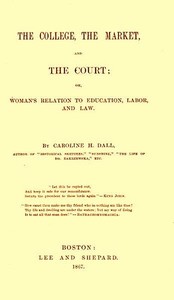
The College, the Market, and the Court or, Woman's relation to education, labor and law — Story, Setting & Ideas

(0 User reviews)   1247
Dall, Caroline Wells Healey, 1822-1912 Project Gutenberg 2013 Not confirmed
Women -- Employment; Women -- Education; Women -- Legal status, laws, etc. Readers of public-domain and historical texts
Project Gutenberg digital edition en

Edition facts

Words 141,487
Reading time 616 min
Text sections 15

For The College, the Market, and the Court or, Woman's relation to education, labor and law — Story, Setting & Ideas, the stored edition analysis reports 141,487 words, 10 hr 16 min estimated reading time, and 15 detected text sections.

The text analysis averages about 21.7 words per sentence, while the detected sections provide another way to judge how the source is divided.

Project Gutenberg metadata also associates the work with “Women -- Employment,” connecting these edition facts with the source record’s subject description.

Explore this collection

Compare your next read

These alternatives are selected using recorded categories and estimated reading time.

Search stored excerpts and compare books → Choose by your preferences →

How these choices and excerpts are prepared

Choices use stored catalog measurements. Estimates vary with reading speed. A shared category is a catalog label, not a claim that two books have the same argument or literary quality.

Search reads excerpt text stored with this catalog and links to its associated Gutenberg record. The connection is stored in the site database; this tool does not recheck that every excerpt is word-for-word identical to that external record. Excerpt search does not cover every chapter and does not verify historical publication dates.

Catalog snapshot checked: 2026-09-25. Coverage: 90 public books, 90 available source excerpts.

Caroline H. Dall's 1867 work examines women's access to education, labor, and law through lectures that blend historical evidence, cross-cultural comparisons, and personal narrative. The author's preface reveals the controversy surrounding her discussion of prostitution as a result of low wages, and the text draws on sources from Hindu scripture to contemporary travelogues.
Share
Editorial Edition Score 4.8/5

Calculated from edition completeness, EPUB availability, text structure and catalogue metadata. Not a user rating.

How this score is calculated
  • Description quality20 pts
  • Title & short description10 pts
  • Source metadata20 pts
  • Text length15 pts
  • Chapters / structure15 pts
  • EPUB file integrity20 pts

Total of 100 points, scaled to a 2.5-5.0 range. Editions with an empty description or a missing EPUB file are not scored.

Edition quality

Public-domain source text

Read the source text

The source text is kept in the dedicated reader, separate from this catalogue record and its commentary.

Caroline H. Dall opens her preface with a striking admission: the second course of lectures, on labor and prostitution, provoked such opposition that she wrote private notes to leading clergymen, demanding their attendance as an act of justice. This defensive posture colors the entire work, which is neither a detached treatise nor a fiery manifesto but a careful, evidence-laden argument. Dall weaves together ancient Hindu laws, Chinese customs, and reports from travelers like Köhl, using each to illustrate the historical subordination of women. Yet she also highlights exceptions—the female chiefs of the Garo people, the Begum of Lumroom who fought the Duke of Wellington—suggesting that women's capacities have been recognized in scattered times and places. The result is a book that moves from defensive apology to global survey, then back to pointed social critique.

A Preface That Defends Before It Explains

The preface, titled “A Preface to Be Read After the Book,” is itself a revealing document. Dall recounts how she was pressured to drop the subject of prostitution, which she frames as the result of low wages. She did not yield, she says, because she was “not working for myself nor of myself.” This claim of impersonal mission recurs throughout the text, lending a tone of reluctant duty. The preface also establishes a pattern: Dall anticipates criticism and preemptively justifies her methods. She notes that the lectures were “fully attended and frequently repeated,” and that white-haired clergymen set aside their prejudices to attend. This defensive framing shapes the reader’s expectation: the book is not a neutral survey but a response to active opposition.

Cross-Cultural Evidence as Argument

Dall’s method is comparative and historical. She quotes Vishnu Sarma on women’s inconstancy, then immediately undercuts the authority by noting that such sayings “save modern women from any very strong desire to restore the ‘good old rule.’” She moves from Hindu scripture to Chinese writers, to Turkish customs, to the convent of Nuestra Senhora da Ajuda in Rio, where husbands locked up wives during travel. Each example is chosen to show a consistent pattern of control. Yet Dall also includes counterexamples: the republican government of Celebes where women serve as presidents, and the Garo people where property descends through the female line. These exceptions are not mere curiosities; they serve as proof that women’s subordination is not natural but contingent on custom and law.

Voice and the Shifting Pace of Persuasion

Dall’s narrative voice shifts noticeably between sections. In the preface, she is personal and defensive, using first-person anecdotes about letters and tickets. In the body, she adopts a scholarly, almost encyclopedic tone, piling up examples from ancient and foreign sources. The pace is deliberate, each paragraph a new piece of evidence. But occasionally the voice sharpens into irony: after quoting the Hindu law that a widow should burn herself, she remarks that many women “had been burnt during her whole conjugal life in the fires of tyranny.” This sudden shift from reportage to bitter commentary jolts the reader. The alternation between cool exposition and heated aside gives the prose a rhythmic tension, as if Dall is struggling to keep her indignation in check while building an airtight case.

Dall’s book rewards readers who attend to its structure as much as its arguments. The preface, meant to be read last, actually frames the entire work as a response to controversy. The cross-cultural evidence is not random but carefully selected to show both the universality of women’s subordination and the existence of alternatives. Pay attention to the moments when Dall’s voice breaks from scholarly neutrality into irony or anger—these are the hinges of her argument. The book is best read as a series of lectures, each building on the last, with the preface serving as a key to understanding why Dall chose to write in this particular way.

I came across Dall's careful, almost pained accounting of how little women's labor was worth, and found myself remembering another book—one that traces a district where women's circumstances were even more brutally prescribed. That quiet footnote about low wages leading elsewhere seemed to echo across continents and years. Holding both together felt like honoring a thread of shared history. The nightless city; or, The "history of the Yoshiwara Yūkwaku" — Themes and Context lingered beside it, unresolved, but connected.

There are no reviews for this eBook.

0
0 out of 5 (0 User reviews )

Add a Review

Your Rating *
There are no comments for this eBook.

Reader reflection

What did you think of this book?

Answer a few questions and save a private reflection on this device.

Your progress 0 / 10
1

Which reading stage best describes you?

2

What was your overall reaction to the book?

3

Would you recommend this book to another reader?

4

What was the reading difficulty like?

Related eBooks