About 723 minutes
Trial of William Palmer — A Closer Reading
Historical Psychological Social Fiction
166,195 recorded words. 8 minutes difference from this book's estimate.
View Gutenberg source #52264
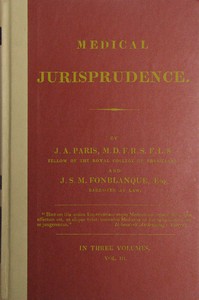
Medical Jurisprudence, Volume 3 (of 3) — A Reader’s Guide can be approached with a clearer sense of reading commitment from its source measurements: 164,378 words, 11 hr 55 min estimated reading time, and 42 detected text sections.
The text analysis averages about 25.5 words per sentence, while the detected sections provide another way to judge how the source is divided.
Project Gutenberg metadata also associates the work with “Medical laws and legislation -- Great Britain,” connecting these edition facts with the source record’s subject description.
Explore this collection
These alternatives are selected using recorded categories and estimated reading time.
About 723 minutes
Historical Psychological Social Fiction
166,195 recorded words. 8 minutes difference from this book's estimate.
View Gutenberg source #52264About 636 minutes
Historical Psychological Social Fiction
146,091 recorded words. 79 minutes difference from this book's estimate.
View Gutenberg source #55668About 627 minutes
Historical Psychological Social Fiction
144,164 recorded words. 88 minutes difference from this book's estimate.
View Gutenberg source #40076Search stored excerpts and compare books → Choose by your preferences →
Choices use stored catalog measurements. Estimates vary with reading speed. A shared category is a catalog label, not a claim that two books have the same argument or literary quality.
Search reads excerpt text stored with this catalog and links to its associated Gutenberg record. The connection is stored in the site database; this tool does not recheck that every excerpt is word-for-word identical to that external record. Excerpt search does not cover every chapter and does not verify historical publication dates.
Catalog snapshot checked: 2026-09-25. Coverage: 90 public books, 90 available source excerpts.
Calculated from edition completeness, EPUB availability, text structure and catalogue metadata. Not a user rating.
Total of 100 points, scaled to a 2.5-5.0 range. Editions with an empty description or a missing EPUB file are not scored.
Public-domain source text
The source text is kept in the dedicated reader, separate from this catalogue record and its commentary.
The third volume of Medical Jurisprudence departs from the systematic exposition of earlier volumes to present a compendium of statutes, legal cases, and medical reports spanning the 15th to early 19th centuries. The work opens with a detailed table of contents listing over forty documents, including charters of the College of Physicians, midwives' oaths, and reports on plague and murder trials. This structural shift from treatise to sourcebook foregrounds the evidentiary basis of medical-legal reasoning.
The excerpts reveal a work organized around the interplay between statutory law and judicial interpretation. The lengthy account of Dr. Bonham's case (1606) exemplifies this: the College of Physicians' censors examine Bonham, find him insufficient, and amerce him for disobedience, while Bonham asserts that university doctors are exempt from their authority. The Latin legal pleadings and English commentary create a bilingual texture that underscores the historical roots of medical regulation.
The volume's first part reproduces statutes from 9 Hen. 5 to 59 Geo. 3, interspersed with charters and royal letters. These documents are not merely appended but serve as the legal skeleton for the entire work. The Charter of the Apothecaries and the College of Physicians' charter appear alongside parliamentary acts that confirm or modify their powers. The inclusion of the midwife's oath and certificate suggests a concern with regulating all levels of medical practice.
The arrangement follows a chronological logic, yet the selection reveals thematic priorities: the 32 Hen. 8, c. 40 and 42 deal with physicians' privileges, while the 18 Geo. 2, c. 15 addresses surgeons. The reader encounters a layered legal landscape where royal prerogative, parliamentary statute, and professional bylaw coexist. The repeated phrase in tam amplo & largo modo (in as ample and large a manner) from the 1 Mary statute signals the expansive interpretation granted to the college's authority.
The extended excerpt from Dr. Bonham's case (1606) occupies a central position in the appendix. The narrative unfolds through legal pleadings: Bonham is summoned, examined, found insufficient, and amerced 100s. for disobedience. His refusal to submit—nulla a collegio petita venia (without seeking leave from the college)—and his claim that university doctors are exempt crystallize a jurisdictional dispute that resonates through later cases.
The text reproduces the censors' warrant and the return to a habeas corpus, offering a procedural anatomy of medical discipline. The case of Groenvelt v. Burwell and Dr. Stanger's case follow, creating a sequence that tests the boundaries of college authority. The reader observes how legal forms—amercement, commitment, examination—translate medical judgment into coercive power. The Latin phrases (minus sufficiens, inobedientia et contemptus) become recurring motifs that link individual cases to broader principles.
Part III of the volume shifts from statutes to medical reports in notable criminal cases. The College of Physicians' report on Joseph Lane's murder (1632) and the Surgeons of Edinburgh's report on the Standsfield case illustrate how medical experts shaped legal outcomes. The extracts from Spencer Cowper's case and Mary Blandy's trial show physicians testifying on cause of death, poisoning, and physical evidence.
The inclusion of Eugene Aram's defense—a speech rather than a medical report—broadens the evidentiary scope to include rhetorical strategies. The cases of Donellan and Donnall, both involving poisoning, allow comparison of medical reasoning across similar fact patterns. The volume does not provide full trial transcripts but selects passages where medical testimony is pivotal, creating a mosaic of forensic practice. The reader sees how doctors moved from bedside observation to courtroom testimony, translating physiological phenomena into legal proof.
Throughout the excerpts, the human body appears as an object of examination, measurement, and legal classification. In the section on rape, physiological illustrations accompany legal definitions. The discussion of real and apparent death, syncope, and sudden death treats the body as a site of ambiguity where medical knowledge must distinguish life from death, volition from accident.
The phrase minus sufficiens (insufficient) recurs in Bonham's case, linking medical competence to legal fitness. The midwife's oath requires her to swear to report bastard children and stillbirths, making her a witness to bodily events. The report on the plague (1819) transforms epidemic disease into a matter of quarantine and commerce. These recurring images—the examined body, the insufficient practitioner, the oath-bound witness—create a cohesive thematic thread across disparate documents. The volume's structure, moving from statute to case to report, mirrors the movement from abstract rule to concrete application, always returning to the body as the ultimate object of medical-legal attention.
Readers approaching this volume should treat it as a reference work best navigated by its detailed table of contents. The Latin legal phrases and archaic statutory language may require patience, but they reward close reading with insights into the historical formation of medical regulation. The cases of Bonham, Standsfield, and Blandy offer entry points for understanding how legal procedures shaped medical authority. For those interested in the evolution of forensic medicine, this collection provides primary sources that illuminate the contested boundaries between professional judgment and legal power.
There’s something oddly consoling in these old casebooks—how the law tried to make sense of bodies and fires and sudden quiet. It reminds me of the steadiness I felt reading The Institutes of Justinian — Inside the Classic, another voice from long ago, trying to order the chaos of human affairs. Both feel like holding a lantern in a very old hallway.
Create a short personal record of your experience with this book.