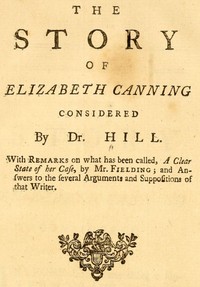
John Hill opens his 1753 pamphlet with a defensive posture, insisting his conduct in the Elizabeth Canning affair needs no defense. He claims to act from "real Honesty and public Utility," a phrase that signals the moral and legal stakes of his intervention. The text immediately positions itself as a corrective to Henry Fielding's A Clear State of her Case, promising to answer that writer's arguments. Hill's prose is marked by a combative, syllogistic style—he addresses an imagined opponent as "Syllogist" and peppers his paragraphs with rhetorical questions. This is not a neutral report but a lawyerly brief, built on the assumption that the reader already knows the outlines of the case.
The Rhetoric of Certainty
Hill's diction repeatedly asserts unshakeable conviction. He writes of "the Truth, on the Evidence of which the Life of a most injur'd Person depends," and declares himself "convinced it needs no Defence." This absolute language is strategic: it preempts criticism by framing doubt as malice. Yet the pamphlet's very existence undercuts this pose—if the case were truly beyond question, no rebuttal would be necessary. Hill's tone oscillates between wounded pride and moral outrage, as when he dismisses "the Malice of little Adversaries." The reader is invited to see Hill as a disinterested truth-seeker, though he admits to having acted "under the Colour of public Information." This tension between claimed impartiality and evident partisanship shapes every paragraph.
The Problem of Witness Testimony
Hill zeroes in on the mechanics of how witness statements were obtained. He notes that Virtue Hall gave her information on February 14, after hearing Elizabeth Canning's story multiple times—first at Enfield on February 1, then at Mr. Tyshmaker's, and later through newspaper accounts. Hill argues that Hall's ability to repeat Canning's narrative proves nothing about its truth; it merely shows she had heard it. More damningly, he points out that the same attorney drafted both women's sworn informations. "The same Person drew both," Hill writes, implying collusion. He contrasts this with their oral testimony at trial, which did not coincide. This distinction between written and spoken evidence is the pamphlet's sharpest forensic point.
The Specter of Perjury and Conscience
Hill dwells on the psychological consequences of false swearing. He asks rhetorically whether anyone can claim never to have felt "a Pang of Conscience," and describes the perjurer's inevitable remorse: "Terror, Anguish, and Remorse; Wishes to speak, and Eagerness to do it." This is not abstract moralizing; it is a direct argument about the behavior of a key witness who recanted. Hill insists that her recantation bears "as much Face of Truth" as her original oath, given the natural pressure of guilt. He frames the recantation as a return to truth after a period of fear-induced falsehood. The passage reveals Hill's reliance on a psychology of conscience that he assumes is universal, even as he acknowledges that some—"the Ideot, the Atheist"—might deny it.
The Structure of Rebuttal
Hill organizes his pamphlet as a point-by-point response to Fielding, though the excerpts show only the opening and a later passage. The structure is forensic: he poses objections, then demolishes them. For instance, he anticipates the argument that two witnesses agreeing in detail proves their story true, and counters with a syllogism: if one heard the other's story, or if the same attorney wrote both statements, agreement proves nothing. Hill's method is cumulative—he piles up circumstantial details (dates, locations, the role of the attorney) to create an impression of overwhelming evidence. The reader is led through a maze of procedural critique, always returning to the central claim that the prosecution's case was manufactured.
Hill's pamphlet is best read as a specimen of eighteenth-century legal polemic, where rhetorical force often substitutes for judicial proof. Readers should attend to how Hill constructs authority—through appeals to unnamed higher judges, through displays of logical rigor, and through the persona of the disinterested gentleman. The excerpts do not reveal whether Hill's arguments prevailed, but they show how a controversial case could be reframed as a battle over the credibility of witnesses and the integrity of legal process. For those interested in the Canning affair, Hill's text offers a vivid counterpoint to Fielding's account.
Reading John Hill’s scrutiny of sworn testimony, I thought of my grandfather’s old law books, the way he’d mutter over contradictions in witness accounts. That same unease—how easily memory bends under pressure—came back with Science and the Criminal — Edition Insights, though from a colder, more forensic angle. It made me wonder if certainty is ever truly more than a carefully arranged story.