About 59 minutes
The Story of Elizabeth Canning Considered — Text and Context
Science Fiction Utopias
13,549 recorded words. 1 minutes difference from this book's estimate.
View Gutenberg source #51334
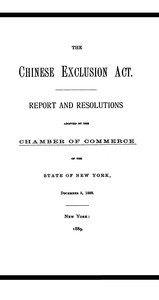
The source record for The Chinese Exclusion Act Report and Resolutions Adopted by the Chamber of Commerce of the State of New York — Inside the Classic measures this digital text at 13,308 words, 58 min estimated reading time, and 3 detected text sections.
The text analysis averages about 29.3 words per sentence, while the detected sections provide another way to judge how the source is divided.
Project Gutenberg metadata also associates the work with “United States. Chinese Exclusion Act,” connecting these edition facts with the source record’s subject description.
Explore this collection
These alternatives are selected using recorded categories and estimated reading time.
About 59 minutes
Science Fiction Utopias
13,549 recorded words. 1 minutes difference from this book's estimate.
View Gutenberg source #51334About 49 minutes
Science Fiction Utopias
11,219 recorded words. 9 minutes difference from this book's estimate.
View Gutenberg source #22684About 82 minutes
Science Fiction Utopias
18,697 recorded words. 24 minutes difference from this book's estimate.
View Gutenberg source #71475Search stored excerpts and compare books → Choose by your preferences →
Choices use stored catalog measurements. Estimates vary with reading speed. A shared category is a catalog label, not a claim that two books have the same argument or literary quality.
Search reads excerpt text stored with this catalog and links to its associated Gutenberg record. The connection is stored in the site database; this tool does not recheck that every excerpt is word-for-word identical to that external record. Excerpt search does not cover every chapter and does not verify historical publication dates.
Catalog snapshot checked: 2026-09-25. Coverage: 90 public books, 90 available source excerpts.
Calculated from edition completeness, EPUB availability, text structure and catalogue metadata. Not a user rating.
Total of 100 points, scaled to a 2.5-5.0 range. Editions with an empty description or a missing EPUB file are not scored.
Public-domain source text
The source text is kept in the dedicated reader, separate from this catalogue record and its commentary.
The New York Chamber of Commerce's 1889 report opens with a letter from railroad magnate C. P. Huntington, who frames the Chinese Exclusion Act as a partisan maneuver that damages American trade. Huntington warns that China can retaliate without force: American agents in Chinese ports report that buyers simply stopped purchasing cotton textiles after the act passed, turning to English and German suppliers. The report thus begins not with abstract principle but with a concrete commercial loss, setting the tone for a document that treats the exclusion policy as a self-inflicted wound to national prosperity.
The report's central argument is economic, not humanitarian. It contends that Chinese laborers provided cheap, tractable labor needed to develop the American West, and that excluding them hurts both the labor supply and trade with China. The authors cite Huntington's observation that the act caused an immediate drop in sales of coarse cotton textiles, with Chinese buyers offering no explanation—simply refusing to buy. The report warns that petroleum and machinery trades will follow if the U.S. does not reverse course. This focus on material self-interest distinguishes the Chamber's stance from moral appeals, grounding opposition in balance sheets rather than sympathy.
The report invokes the Burlingame Treaty of 1868, which recognized the right of free migration and granted most-favored-nation status to both Chinese in the U.S. and Americans in China. It notes that the Supreme Court upheld the 1882 act as within the 1880 Supplementary Treaty, but the Chamber implies that the Exclusion Act exceeds those limits. A lengthy excerpt from Justice Field's opinion describes Chinese laborers as unable to assimilate due to physical characteristics and habits, living on minimal fare and undercutting white workers. The report includes this passage without endorsement, letting the court's own language reveal the racial logic behind the law—a logic the Chamber challenges on commercial grounds.
The report's resolutions, adopted December 5, 1889, call for repeal of the Exclusion Act. The Chamber argues that the law violates treaty commitments, damages American exports, and fails to address the real needs of labor. It emphasizes that China can retaliate without formal action, simply by shifting purchases to European competitors. The document thus presents a unified business front: the act is not only unjust but counterproductive, harming the very industries it purports to protect. The Chamber's voice is that of commercial pragmatism, urging lawmakers to prioritize trade over nativist sentiment.
Readers should note that this report represents only one faction—Eastern commercial interests—in a national debate. The excerpts do not include the full text of the act or responses from labor groups. The Chamber's argument is selective, emphasizing trade losses while omitting the social tensions that drove the legislation. For a fuller picture, compare this document with congressional debates and West Coast labor publications from the same period.
There’s something touching about a business lobby arguing, in 1889, that exclusion laws hurt commerce and treaty promises—practical men, quietly insisting the country keep its word. I remember that report the way one remembers a faded photograph: formal, earnest, a little sad. It reminds me of old rulebooks, like Mining Laws of Ohio, 1921 — Key Ideas to Explore, where every statute feels like a small, forgotten act of hope.
Use these questions to collect your thoughts before moving on.