About 102 minutes
An Account of the Late Intended Insurrection among a Portion of the Blacks of this City — A Closer Reading
Fantasy Juvenile Worlds
23,324 recorded words. 54 minutes difference from this book's estimate.
View Gutenberg source #60349
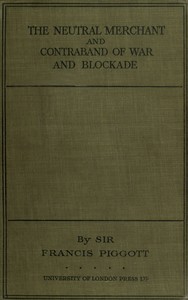
The neutral merchant in relation to the law of contraband of war and blockade under the order in Council of 11th March, 1915 — Themes and Context can be approached with a clearer sense of reading commitment from its source measurements: 35,779 words, 2 hr 36 min estimated reading time, and 9 detected text sections.
The text analysis averages about 31.4 words per sentence, while the detected sections provide another way to judge how the source is divided.
Project Gutenberg metadata also associates the work with “World War, 1914-1918,” connecting these edition facts with the source record’s subject description.
Explore this collection
These alternatives are selected using recorded categories and estimated reading time.
About 102 minutes
Fantasy Juvenile Worlds
23,324 recorded words. 54 minutes difference from this book's estimate.
View Gutenberg source #60349About 214 minutes
Fantasy Juvenile Worlds
49,122 recorded words. 58 minutes difference from this book's estimate.
View Gutenberg source #19019About 90 minutes
Fantasy Juvenile Worlds
20,509 recorded words. 66 minutes difference from this book's estimate.
View Gutenberg source #26133Search stored excerpts and compare books → Choose by your preferences →
Choices use stored catalog measurements. Estimates vary with reading speed. A shared category is a catalog label, not a claim that two books have the same argument or literary quality.
Search reads excerpt text stored with this catalog and links to its associated Gutenberg record. The connection is stored in the site database; this tool does not recheck that every excerpt is word-for-word identical to that external record. Excerpt search does not cover every chapter and does not verify historical publication dates.
Catalog snapshot checked: 2026-09-25. Coverage: 90 public books, 90 available source excerpts.
Calculated from edition completeness, EPUB availability, text structure and catalogue metadata. Not a user rating.
Total of 100 points, scaled to a 2.5-5.0 range. Editions with an empty description or a missing EPUB file are not scored.
Public-domain source text
The source text is kept in the dedicated reader, separate from this catalogue record and its commentary.
Sir Francis Piggott, former Chief Justice of Hong Kong, opens this 1915 work by framing the British Order in Council of 11 March 1915 as a direct response to the German submarine menace. The Order, he explains, was designed to strangle enemy commerce through reprisals, deliberately avoiding the 'legal niceties' of blockade declarations. Piggott immediately positions himself against the United States Government's protests, which he characterizes as prioritizing commercial interests over belligerent necessity. The text, reprinted from three articles in The Nineteenth Century and After, is structured as a point-by-point legal rebuttal, with Piggott asserting that international law must not 'set the profit of the merchant above the life of nations.'
Piggott carefully distinguishes the Order in Council from a traditional blockade. He notes that the Order was 'wider in its scope than any list of contraband' and 'free from the legal niceties which surround a declaration of blockade.' This distinction is central to his argument: the Order is a reprisal, not a blockade, and thus falls outside the strictures of conventional maritime law. He repeatedly emphasizes that the British Government's action was a justified response to German submarine warfare, which he calls a 'flagrant breach of the laws of humanity and war.' By framing the Order as a reprisal, Piggott sidesteps the need to conform to blockade precedents, instead grounding the legality in the belligerent's right to retaliate against unlawful enemy tactics.
Piggott directly contests the core doctrines that neutral governments, particularly the United States, relied upon to protest the Order. He denies that belligerents have merely a 'right of visit and search' or a 'right to establish and maintain a blockade'—instead, he asserts these are belligerent rights that can be exercised against neutral merchants rendering services to the enemy. He argues that 'a nation's sovereignty over its own ships and citizens under its own flag on the high seas' does suffer 'diminution in times of war' to the full extent of these belligerent rights. This is a fundamental redefinition of the relationship between neutral commerce and belligerent power, one that subordinates the former entirely to the exigencies of war. Piggott's language is combative: he accuses the US of abandoning 'the dispassionate attitude which neutrality requires' and of rendering 'material assistance' to the enemy.
Piggott devotes considerable attention to dissecting the American Protest, which he treats as a flawed legal document. He criticizes it for 'enunciating old doctrines in their popular form without that full examination of the underlying principles which the grave state of the world's affairs demands.' He finds the Protest's constructive side 'interesting and worthy of careful study' but its destructive side lacking. Piggott's method is to contrast the US position—that the conduct of war should be governed by commercial interests—with his own view that 'commerce, in so far as it touches the interests of the belligerents, is entirely subordinated to the exigencies of war.' He repeatedly returns to the idea that the US, by insisting on its interpretation of international law, is effectively siding with Germany. The tone is sharp, as when he writes that 'the proposed remedy will hardly cure the disease' in reference to US proposals for post-war maritime rules.
Readers should approach this text as a wartime polemic grounded in legal reasoning, not as an impartial treatise. Piggott writes from a clear belligerent perspective, and his arguments are shaped by the urgency of 1915. The excerpts reveal a work that is as much about the philosophy of international law—the balance between belligerent rights and neutral commerce—as it is about the specific Order. Pay attention to how Piggott uses historical precedents (such as the Behring Sea Arbitration) and how he frames the US protest as a threat to British victory. The text rewards careful reading of its legal distinctions, particularly between reprisal, blockade, and contraband.
I remember sitting with my grandfather’s old law books, smelling dust and ink. That 1915 pamphlet’s cold logic about wartime necessity felt strangely like the moment in The Seven Lamps of Advocacy where justice bends to rhetoric—not the ideal, but the argument’s stubborn weight. The Seven Lamps of Advocacy — Themes and Context once offered that same quiet ache: law as human compromise, never quite pure.
Create a short personal record of your experience with this book.