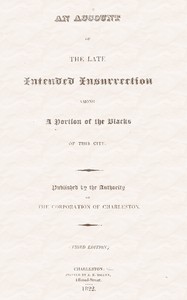
The document opens with a city council resolution requesting the Intendant to prepare an account of the 'late intended Insurrection.' In his preface, Intendant James Hamilton Jr. acknowledges the difficulty of deciding what to publish or suppress, ultimately choosing 'full publication' to avoid appearing timid or unjust. He frames the account as both a justification of the laws and a warning: 'there is nothing they are bad enough to do, that we are not powerful enough to punish.' This rhetorical posture—simultaneously defensive and menacing—colors the entire narrative.
The Structure of Official Testimony
The main body consists of transcribed examinations of enslaved witnesses, each labeled with a letter and the witness's name (e.g., '(D.) Examination of Frank, a negro man belonging to Mrs. Ferguson'). These depositions are presented as direct speech, with minimal editorial intervention. The repetition of formulaic openings—'I know Denmark Vesey, and have been to his house'—creates a rhythm of accusation. The text interleaves these testimonies with summaries of events, such as the initial report on May 30, 1822, when a 'gentleman of great respectability' relayed his slave's market conversation. The structure prioritizes legal documentation over narrative flow, reflecting the document's dual purpose as record and deterrent.
Diction of Authority and Fear
Hamilton's language oscillates between bureaucratic precision and emotional appeal. He describes the plot as a 'commotion' and a 'revolt,' but also as a 'contemplation among a proportion at least of our black population.' The qualifier 'at least' hints at uncertainty while amplifying threat. In the preface, he uses the passive voice ('was informed,' 'was forthwith summoned') to emphasize institutional response. The witnesses, by contrast, speak in active, vernacular phrases: Vesey 'advised me to join, and rise'; he said 'the negroe's situation was so bad, he did not know how they could endure it.' This contrast in diction—measured official prose versus raw reported speech—highlights the power asymmetry embedded in the text.
Recurring Details in Witness Accounts
Several motifs recur across testimonies. Vesey is consistently portrayed as a planner who 'was going about to see different people' and who named co-conspirators like Ned Bennett, Peter Poyas, and Monday Gell. The plan's specifics appear repeatedly: an attack 'about 12 o'clock at night,' parties landing on South Bay and Wappoo, and the goal to 'take the Magazines and Guard Houses, and the City.' Witnesses mention money changing hands—Vesey gave 'two dollars to Jesse' for a horse, and others contributed '25 cents a piece.' These concrete details lend credibility but also reveal the authorities' interest in documenting a coordinated conspiracy. The repetition of names, locations, and sums creates a mosaic of alleged collaboration.
The Voice of Denmark Vesey as Reported
Though Vesey himself does not speak directly in the excerpts, his words are filtered through multiple witnesses. Frank reports Vesey saying 'the negroes were living such an abominable life, they ought to rise' and that he 'wanted to stay and see what he could do for his fellow creatures.' Another witness recalls Vesey's threat: 'if my own father does not assist, I will cut off his head.' These reported statements paint Vesey as both an ideologue and a militant leader. The text does not include his defense or cross-examination, leaving his voice mediated by those who testified against him. Readers must weigh the reliability of these secondhand accounts, noting the incentives for witnesses to cooperate with authorities.
This edition preserves the original 1822 pamphlet's typography and formatting, including the use of italics and small caps for emphasis. Readers should attend to the gaps between official framing and witness testimony, and consider how the document's structure—alternating between narrative and deposition—shapes perceptions of the events. The text is a primary source for understanding both the conspiracy and the mechanisms of control in antebellum Charleston.
Reading the transcribed confessions in the 1822 report, I kept thinking how laws are often built on hurried, frightened words. That tension stays with me when I return to Popular Law-making A study of the origin, history, and present tendencies of law-making by statute — Context and Discussion—how the cold statutes we inherit were once someone’s messy, contested moment. It makes the quiet archives feel heavier, somehow.