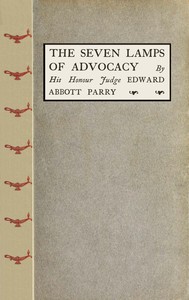
Sir Edward Parry opens The Seven Lamps of Advocacy by comparing the great advocate to the great actor: both fill the stage for a span, succeed, gain applause, and then the curtain falls. He immediately warns the young student that advocacy, like acting, has no single correct method—yet insists that principles do exist and can be learned from the stored-up experience of elders. Parry positions himself as a digger through 'forbidding masses of decaying biography' and 'mouldering law reports' to recover the paths of forgotten advocates. This framing sets the tone for a work that is part historical sketch, part practical manual, and part moral exhortation.
The Lamp of Honesty and the Elusive Art
In the first chapter, Parry argues that honesty is the foundational lamp, yet he devotes much of his opening to the difficulty of defining advocacy itself. He notes that methods of past masters like Erskine, Hawkins, or Russell were often 'new and startling to their own generation,' and that youth is prone to believe there are no principles at all. The author's own method is to search 'diligently' through old records to discern a 'race of worthy men' haunting libraries and ancient halls. This section establishes that Parry is not offering a rulebook but a collection of examples from which the reader must extract usable lessons.
Eloquence and the Mechanics of Persuasion
Parry devotes a full lamp to eloquence, distinguishing between styles. He contrasts Charles Russell, who 'did not seek to persuade, he directed the court and jury,' with Sir Edward Clarke, who could 'insinuate doubts into the hearts of the jury' and become 'the thirteenth man on the jury.' The author warns against bombast, citing the cheesemonger's 'bloom upon a peach' as a fatal misstep. Yet he insists that the mechanics of eloquence—like Demosthenes with pebbles or Cicero taking lessons—can be learned. The golden principle, quoting Lord Chesterfield, is that eloquence addresses the heart, not the brain: 'Gain the heart, or you gain nothing.'
Judgment and the Limits of Dominance
Parry's lamp of judgment examines the advocate's ability to read a case and a jury. He notes that even Russell, who dominated every courtroom, could not dominate a jury in a doubtful case. The author draws a sharp distinction between the advocate who imposes his will and the one who leaves arguments so clearly that he becomes an invisible presence in the jury room. This section suggests that judgment is not merely legal knowledge but a kind of tactical wisdom—knowing when to press and when to withdraw. Parry's examples, drawn from reported cases and biographies, reinforce that the best advocates adapt their style to the circumstances.
Fellowship and the Professional Tradition
The final lamp, fellowship, turns to the advocate's relationship with the profession and the public. Parry emphasizes that advocacy is a 'great profession' with traditions worth preserving. He praises the 'stored-up experience of elders' and the 'race of worthy men' who preceded him. The tone here is elegiac: Parry worries that a 'race of moderns' may care for none of these things. Yet he does not simply lament; he offers the book itself as an attempt to 'recapture something of the lives of these great ones.' The lamp of fellowship thus becomes a call to collegiality and historical awareness, urging the reader to see themselves as part of a lineage.
Parry's book is best approached as a series of character sketches and cautionary tales rather than a systematic treatise. Readers should note how each lamp is illustrated by specific anecdotes—the cheesemonger's bloom, the interrupted bird simile, Russell's dominance—and consider how these examples reveal the author's own values. The work rewards those who read with an eye for the tension between principle and practice, and who are willing to extract their own lessons from the 'dusty gauzes of forgotten years.'
I found myself drifting back to that old 1923 book, the one about the seven lamps of advocacy, and how Parry spoke of courage as a quiet, steady thing. It made me think of another account entirely, one I keep meaning to revisit: An Account of the Late Intended Insurrection among a Portion of the Blacks of this City — A Closer Reading. There, too, courage isn't loud; it's just a held breath in a doorway, waiting.