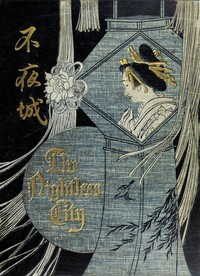
De Becker's The Nightless City opens not with narrative but with a table of contents that reads like an inventory: history, dykes, willow trees, shrines, gate regulations, brothel classes, tea-houses, and dialect. This catalog-like structure immediately signals that the work is a compendium, not a continuous history. The epigraph from Ieyasu's legacy frames the quarter as a "necessary evil," setting a tone of detached documentation rather than moral judgment. A first reader should expect systematic classification rather than storytelling.
The Opening as a Guide to Structure
The initial pages establish a pattern of numbered sections and subheadings that organize the Yoshiwara's physical and social geography. The table of contents lists over fifty entries, from "Nihon-dzutsumi (The Dyke of Japan)" to "Magic Charms." This taxonomy invites readers to dip in and out, treating the book as a reference work. The opening also includes a transcriber's note about illustrations, hinting at the visual evidence that supplements the text. For a first reading, the table of contents is the best map: it reveals that the book prioritizes categories over chronology, and that each section can stand alone.
Mid-Text Detail: Costume as Evidence
In the middle excerpts, De Becker devotes pages to the dress of courtesans, describing fabrics, colors, and patterns with precision. He notes that in the Bunkwa era, shikake robes were "either black or green" and embroidered with dragons, clouds, or peonies. He records the uchi-hachi-mon-ji walk, with toes pointed inward, and the introduction of three-legged clogs by a courtesan named Fuyō. These details are not decorative; they serve as primary evidence of social status and change. The description of Ariwara's costume in 1814—modeled on a military officer's robe—illustrates how fashion could signal aspiration. A first reader should attend to such passages as micro-histories, where material culture reveals hierarchies and individual agency.
Regulatory Frameworks and Their Limits
Later sections shift to government edicts, medical inspections, and bookkeeping systems. The excerpt on the examination of licensed women at the hospital for venereal complaints shows the bureaucratic apparatus that controlled the quarter. De Becker includes the results of medical inspection and the rules posted at the Great Gate. These passages ground the earlier descriptions of costume and ceremony in a context of regulation and surveillance. However, the excerpts do not reveal how these rules were enforced or resisted. A first reader should note that the book's documentary stance often stops at official records, leaving the lived experience of the women largely inferred.
Language and Terminology as a Lens
Throughout the excerpts, De Becker interjects Japanese terms with translations: ane-jōro (elder-sister harlot), tsuki-dashi (to push out), shikake (loose robe). A dedicated section on "Yoshiwara Dialect" is listed in the contents, suggesting that language itself is treated as a subject. This lexical attention reflects the author's twenty years in Japan and his effort to render the quarter's specialized vocabulary for English readers. For a first reading, these terms are not obstacles but clues: they mark concepts that had no direct English equivalent, such as mi-tate (selection of women) or zegen (procurers). The glossary-like approach reinforces the book's function as a reference, not a narrative.
Because The Nightless City is organized as a series of discrete topics, a first reading can begin with any section that piques interest—costume, dialect, or gate regulations. The table of contents is the best entry point. Readers should treat each section as a self-contained essay, noting how De Becker balances ethnographic detail with official documents. The excerpts offer no overarching argument, but they accumulate into a dense portrait of a regulated world. Approach the book as a cabinet of curiosities, not a linear history.
There’s something genuinely moving about De Becker’s careful catalogs of kimono and courtesans, how order tries to hold a vanished world together. It put me in mind of The Acts of Uniformity: Their Scope and Effect — Themes and Context—both books whisper about rules that shaped intimate lives, then quietly outlived their usefulness. I keep returning to that sad, precise elegance.