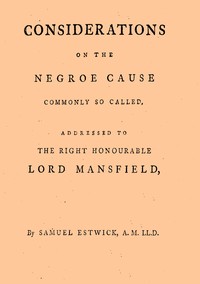
Samuel Estwick's Considerations on the Negroe cause commonly so called opens with a pointed address to Lord Mansfield, the judge whose 1772 Somerset v. Knowles decision had unsettled received opinions on slavery in England. Estwick frames his pamphlet as a review of that case's arguments, aiming to 'fix and ascertain the ground upon which the Owner claimed a right to his Negroe.' The work moves through legal distinctions, natural history, and political reasoning, all structured around a central claim: that English law does not consider enslaved Negroes as 'human beings' for legal purposes. This third edition, published in 1788, responds to the growing abolitionist movement and parliamentary inquiry.
The Distinction Between Slavery and Property
Estwick begins by insisting on a legal distinction between 'slavery' and 'property,' arguing that while slavery involves subjection, property in Negroes is a separate matter governed by purchase. He writes that 'property is the offspring of purchase' and asks, 'if he is his property, who shall disseise him thereof?' This framing allows him to sidestep moral questions about slavery itself and focus on the owner's right under law. He acknowledges that critics might call this 'a distinction without a difference,' but he maintains that English law treats Negroes not as subjects of slavery but as objects of property. The argument hinges on a narrow reading of legal precedent, repeatedly invoking 'matter of fact' as his foundation.
The Physical and Political Motives of the Legislature
Estwick speculates on why Parliament might have excluded Negroes from the category of 'human beings' under law. He proposes two motives: one 'physical,' the other 'political.' The physical motive draws on contemporary natural history debates about the origin of Negroes, their complexion, and 'the woolly covering of their heads so similar to the fleece of sheep.' He references Robert Boyle's inconclusive inquiries into these phenomena, suggesting that their 'very incomprehensibleness' could serve as 'lesser weights in the scales of greater probability.' The political motive, though less developed, implies that legal exclusion was a deliberate policy choice. This section reveals how Estwick weaves scientific uncertainty into legal argument.
Appeals to Authority and the Limits of Reason
Throughout the pamphlet, Estwick balances deference to legal authority with a willingness to engage in speculative reasoning. He asserts that 'authority, however respectable, is not the test of truth,' yet he grounds his case in the 'undeniable proof of self-evidence' from English statutes. When pressed for the reason behind those laws, he retreats to a Greek philosopher's postulate: 'matter of fact is the Δὸς ϖοῦ ϛῶ of my argument'—a fixed point beyond which inquiry is not required. Still, he indulges in 'the suggestions even of fancy and imagination,' acknowledging that such research may not be 'impertinent or unmeaning.' This tension between empirical fact and imaginative conjecture shapes the pamphlet's rhetorical strategy.
The Rhetorical Structure of a Legal Brief
Estwick's pamphlet follows the form of a legal address, with an advertisement, preface, and numbered sections that mimic courtroom argument. The prose is dense with Latin phrases ('Cur, Quare, Quamobrem'), rhetorical questions, and conditional clauses. He frequently addresses Lord Mansfield directly ('my Lord'), creating an impression of oral argument. The structure moves from establishing a factual basis (the Somerset case) to legal analysis, then to speculative motives, and finally to broader implications. This scaffolding allows Estwick to present his case as both reasoned and urgent, while the repeated appeals to 'self-evidence' and 'matter of fact' attempt to foreclose counterarguments. The pamphlet's architecture thus reinforces its central claim: that the owner's right is a matter of settled law, not moral debate.
Readers approaching Estwick's pamphlet should attend to its layered structure: legal argument, natural history speculation, and political rhetoric intertwine. The excerpts show a writer who insists on narrow legal grounds while reaching for broader justifications. The work is best read as a period artifact of pro-slavery reasoning, revealing how legal formalism and scientific uncertainty were marshaled to defend property in persons. Its value lies not in its conclusions but in the strategies it employs.
That rainy afternoon, I kept circling back to Estwick’s uneasy legal contortions, the way a man’s property claim could be argued with such chilly confidence. Then I reached for something quieter on the shelf, and found Mary Blandy’s trial waiting. It struck me how both cases hinge on a woman’s body as evidence—one fought over in courts, one poisoned at home. Trial of Mary Blandy — Text and Context felt like the human echo of that pamphlet’s cold logic.