About 290 minutes
The Judicial Murder of Mary E. Surratt — Story, Setting & Ideas
Adventure Picaresque Fiction
66,537 recorded words. 6 minutes difference from this book's estimate.
View Gutenberg source #36188
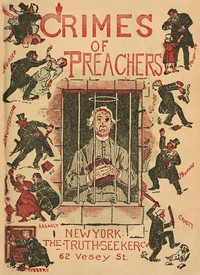
The source record for Crimes of Preachers in the United States and Canada — Story, Setting & Ideas measures this digital text at 65,244 words, 4 hr 44 min estimated reading time, and 6 detected text sections.
The text analysis averages about 9.1 words per sentence, while the detected sections provide another way to judge how the source is divided.
Project Gutenberg metadata also associates the work with “Criminals -- United States,” connecting these edition facts with the source record’s subject description.
Explore this collection
These alternatives are selected using recorded categories and estimated reading time.
About 290 minutes
Adventure Picaresque Fiction
66,537 recorded words. 6 minutes difference from this book's estimate.
View Gutenberg source #36188About 240 minutes
Adventure Picaresque Fiction
55,188 recorded words. 44 minutes difference from this book's estimate.
View Gutenberg source #3291About 333 minutes
Adventure Picaresque Fiction
76,532 recorded words. 49 minutes difference from this book's estimate.
View Gutenberg source #48792Search stored excerpts and compare books → Choose by your preferences →
Choices use stored catalog measurements. Estimates vary with reading speed. A shared category is a catalog label, not a claim that two books have the same argument or literary quality.
Search reads excerpt text stored with this catalog and links to its associated Gutenberg record. The connection is stored in the site database; this tool does not recheck that every excerpt is word-for-word identical to that external record. Excerpt search does not cover every chapter and does not verify historical publication dates.
Catalog snapshot checked: 2026-09-25. Coverage: 90 public books, 90 available source excerpts.
Calculated from edition completeness, EPUB availability, text structure and catalogue metadata. Not a user rating.
Total of 100 points, scaled to a 2.5-5.0 range. Editions with an empty description or a missing EPUB file are not scored.
Public-domain source text
The source text is kept in the dedicated reader, separate from this catalogue record and its commentary.
The work opens not with a sermon but with a wager. In 1906, actor Henry E. Dixey offered $1,000 to charity if it could be shown that ministers were as moral as actors, then another $1,000 if a minister in jail could be found for every state. No one claimed the money. Dixey’s own count found 43 ministers and 19 actors behind bars—a ratio the author considers far too low, noting that in eight months of 1914 the publishers counted over seventy reported offenses warranting imprisonment.
This challenge frames the entire project: a reply to clergy who claim moral guardianship, assembled from newspaper clippings. The book is less a narrative than a ledger, listing hundreds of preachers by name, denomination, location, and alleged crime—from embezzlement and adultery to murder and counterfeiting. The catalog subjects label it “Adventure & Picaresque Fiction,” but the excerpts read more like a prosecutorial dossier.
The Dixey anecdote is the book’s only sustained narrative. After that, the author explains that the work is a direct response to clerical claims of moral superiority. The method is simple: collect newspaper reports of preacher crimes. The author admits the count is incomplete, relying on a clipping service that scanned only major papers. The 1914 tally of seventy-plus cases in eight months is presented as a conservative estimate.
The structure is tabular rather than argumentative. Each entry typically includes the preacher’s surname, first initial, location, denomination, and a short description of the offense. For example: “Hess, Rev. Henry Pennsylvania. Bastardy; girl of sixteen asks him to acknowledge paternity of child.” The repetition of denominations—Methodist, Baptist, Catholic, Presbyterian—creates a cumulative effect. No case is given more than a line or two.
The author does not editorialize within the entries. The indictment is in the accumulation. The catalog subject “Adventure & Picaresque Fiction” seems mismatched; the work has no protagonist, no plot, and no fictional framing beyond the opening challenge.
The bulk of the excerpts consist of a list running from “Hambly, Rev. Mr.” to “Jones, Rev. Mr.” The offenses range widely: fraud, assault, bigamy, drunkenness, counterfeiting, murder, and “improper hypnotic influence over servant girl.” Denominational labels appear consistently—Meth., Bapt., Cath., Pres., Cong., Epis.—suggesting the author wanted to show that no sect was immune.
Some entries include a year, others do not. The years cluster around 1896–1898, with a few from 1906 and 1914. This suggests the compilation drew heavily from a specific period, though the title page claims a “Tenth Edition” and the work was published by the Truth Seeker Company, a freethought publisher. The book’s catalog subjects list “Clergy — Malpractice” but the excerpts show the author uses the term “crimes” broadly, including moral offenses that may not have been illegal.
The list format resists narrative interpretation. There is no attempt to group cases by type or region. The effect is that of a raw data dump, which may be intentional: the author lets the sheer number of entries make the argument.
Scanning the entries, certain denominations recur. Methodists appear frequently—Hambly, Hand, Harwell, Hepp, Hill, Hoover, Hull, Johnson (Bishop), and others. Baptists also feature prominently: Hammond, Hostetter, Howell (R. E.), Hunnycutt, Jernegan, Kirkland. Catholics are listed with “Cath.” and often with “Rev. Father” or “Rev.”—Killeen, Hughes, Jakinowicz. The geographic spread covers New York, Pennsylvania, Illinois, Iowa, Kansas, California, and beyond, suggesting a nationwide scope.
The offenses show a pattern of sexual misconduct, financial crimes, and violence. “Bastardy” and “adultery” appear repeatedly. “Embezzlement” and “swindling” are common. A few entries are startling: “Hermann, Rev. F. Salt Lake City, U. Meth. Charged with murder of two girls; remains in furnace of church; he disappears.” Another: “Jones, Rev. Mr. Monkstown, Tex. Left wife and children; eloped with 16-year-old girl; purs’d by girl’s father (Rev. J. Widsby); shot dead.”
The author does not comment on these patterns. The catalog subject “Criminals — United States” fits, but the work is not about criminals in general—it is specifically about clergy. The secondary topic “religion-theology” is more apt, as the book is a polemic against religious authority.
Readers should approach this work as a period piece of freethought activism, not as a balanced survey. The entries are unverified and drawn from a single source type—newspapers—which may have their own biases. The book’s value lies in its documentation of a specific rhetorical strategy: using the clergy’s own claimed moral standard to indict them. The list format invites browsing rather than continuous reading, and the lack of analysis leaves the reader to draw conclusions from the accumulation of cases.
Some books leave a weight behind, like a quiet room after a loud argument. That clergy catalogue stays with me, not for shock, but for how carefully it records human frailty. It reminded me of another patient chronicle, De Mortuis Nil Nisi Bona Being a Series of Problems in Executorship Law and Accounts — Story, Setting & Ideas, which handles its own somber accounting with a similar, tender restraint. Both simply place the evidence down and let you sit with it.
A brief reflection can help important ideas stay with you longer.