About 24 minutes
The Riot Act — A Reader’s Guide
Adventure Picaresque Fiction
5,502 recorded words. 4 minutes difference from this book's estimate.
View Gutenberg source #8142
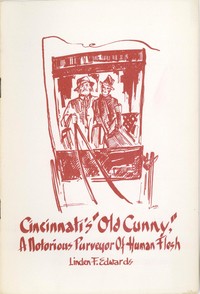
For Cincinnati's "Old Cunny": A Notorious Purveyor of Human Flesh — Text and Context, the stored edition analysis reports 6,352 words, 28 min estimated reading time, and 1 detected text section.
The text analysis averages about 25.7 words per sentence, while the detected sections provide another way to judge how the source is divided.
Project Gutenberg metadata also associates the work with “Medicine -- History,” connecting these edition facts with the source record’s subject description.
Explore this collection
These alternatives are selected using recorded categories and estimated reading time.
About 24 minutes
Adventure Picaresque Fiction
5,502 recorded words. 4 minutes difference from this book's estimate.
View Gutenberg source #8142About 38 minutes
Adventure Picaresque Fiction
8,616 recorded words. 10 minutes difference from this book's estimate.
View Gutenberg source #27740About 54 minutes
Adventure Picaresque Fiction
12,251 recorded words. 26 minutes difference from this book's estimate.
View Gutenberg source #17820Search stored excerpts and compare books → Choose by your preferences →
Choices use stored catalog measurements. Estimates vary with reading speed. A shared category is a catalog label, not a claim that two books have the same argument or literary quality.
Search reads excerpt text stored with this catalog and links to its associated Gutenberg record. The connection is stored in the site database; this tool does not recheck that every excerpt is word-for-word identical to that external record. Excerpt search does not cover every chapter and does not verify historical publication dates.
Catalog snapshot checked: 2026-09-25. Coverage: 90 public books, 90 available source excerpts.
Calculated from edition completeness, EPUB availability, text structure and catalogue metadata. Not a user rating.
Total of 100 points, scaled to a 2.5-5.0 range. Editions with an empty description or a missing EPUB file are not scored.
Public-domain source text
The source text is kept in the dedicated reader, separate from this catalogue record and its commentary.
Linden F. Edwards’s account of William Cunningham, known as “Old Cunny,” opens with a blunt epithet: “Notorious Purveyor of Human Flesh.” The pamphlet, originally published in The Ohio State Medical Journal, relies on newspaper reports and earlier histories to reconstruct the resurrectionist’s career. Edwards’s prose is clinical, yet he does not shy from the period’s vivid characterizations—Cunningham’s widow, for instance, is described as “a bony, brawny-jawed Irish woman, with a mouth like an alligator.” The text balances medical detachment with the sensational language of the era’s crime reporting.
Edwards’s vocabulary consistently frames body snatching as a moral and criminal offense. He uses terms such as “ghoulish resurrectionists,” “nefarious and odious practice,” and “depraved characters.” The word “resurrectionist” itself, a euphemism from the period, appears repeatedly, signaling both the trade’s clandestine nature and its grim association with grave robbing. The author also employs legalistic phrasing: “principals or accessories to the crime of body snatching.” This diction reflects the dual perspective of the article—part historical chronicle, part condemnation of a practice that anatomy laws later rendered obsolete.
The narrative is built on excerpts from Cincinnati newspapers: the Daily Gazette, the Daily Enquirer, and the Ohio State Journal. Edwards quotes these sources directly, letting their language carry the story. For example, a news item from December 1878 reports the arrest of “a gang of resurrectionists consisting of five persons,” including “the widow of Cunningham, of former notoriety in this business.” The reliance on journalistic accounts gives the pamphlet a documentary texture, though Edwards does not verify every claim independently. He notes when a detail—such as the fate of Cunningham’s skeleton—has been “verified by a statement received recently” from the University of Cincinnati.
Edwards explains the mechanics of the body-snatching economy with precision. Medical colleges procured cadavers through intermediaries, typically janitors, so that professors remained ignorant of the bodies’ origins. This arrangement, he argues, “absolved” anatomists of legal culpability. The pamphlet traces Cunningham’s career from his death in 1871 (or 1872) to the eventual housing of his skeleton in a medical museum. Edwards also notes that Cunningham sold his own body to the Medical College of Ohio before his death, and that his widow allegedly received an extra five dollars for “his giant carcass.” Such details underscore the commodification of human remains.
In the closing paragraphs, Edwards shifts from narrative to argument. He contends that the “sins of commission” of resurrectionists were enabled by “sins of omission of the public and of their representatives in the legislative halls,” who refused to pass anatomy laws. This moral calculus reframes the story: the real culprits, in Edwards’s view, were those who failed to provide a legal supply of cadavers for medical education. The pamphlet thus serves not only as a biography of a criminal but as a brief for the necessity of anatomy acts. The final sentence notes that such laws “abolished the need for resurrectionists,” a quiet but pointed conclusion.
Readers should approach this pamphlet as a historical document shaped by its origins in a medical journal. Edwards writes as an anatomist and historian, not a sensationalist, but he reproduces the lurid language of his sources without comment. The text is valuable for its glimpses into nineteenth-century medical ethics, the underground economy of body snatching, and the rhetorical strategies used to condemn or excuse it. The brevity of the work—roughly 6,000 words—makes it a concise entry point into a grisly chapter of American medical history.
Reading about Cunningham’s ledger-like trade, I remembered my grandfather’s old courthouse stories, the way people spoke of bodies as property. It felt like unearthing a cold, clinical voice from another century, so much like the measured arguments I found in The Trial of Jesus from a Lawyer's Standpoint, Vol. 1 (of 2) The Hebrew Trial — Edition Insights, where law and flesh wrestle quietly in the margins.
A brief reflection can help important ideas stay with you longer.