About 513 minutes
The nightless city; or, The "history of the Yoshiwara Yūkwaku" — Themes and Context
Historical Psychological Social Fiction
117,916 recorded words. 14 minutes difference from this book's estimate.
View Gutenberg source #69328
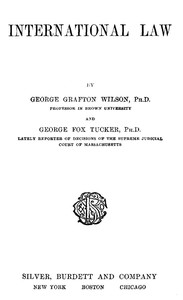
For International Law — Inside the Classic, the stored edition analysis reports 114,687 words, 8 hr 19 min estimated reading time, and 19 detected text sections.
The text analysis averages about 18.8 words per sentence, while the detected sections provide another way to judge how the source is divided.
Project Gutenberg metadata also associates the work with “International law,” connecting these edition facts with the source record’s subject description.
Explore this collection
These alternatives are selected using recorded categories and estimated reading time.
About 513 minutes
Historical Psychological Social Fiction
117,916 recorded words. 14 minutes difference from this book's estimate.
View Gutenberg source #69328About 522 minutes
Historical Psychological Social Fiction
119,848 recorded words. 23 minutes difference from this book's estimate.
View Gutenberg source #15752About 474 minutes
Historical Psychological Social Fiction
108,927 recorded words. 25 minutes difference from this book's estimate.
View Gutenberg source #72689Search stored excerpts and compare books → Choose by your preferences →
Choices use stored catalog measurements. Estimates vary with reading speed. A shared category is a catalog label, not a claim that two books have the same argument or literary quality.
Search reads excerpt text stored with this catalog and links to its associated Gutenberg record. The connection is stored in the site database; this tool does not recheck that every excerpt is word-for-word identical to that external record. Excerpt search does not cover every chapter and does not verify historical publication dates.
Catalog snapshot checked: 2026-09-25. Coverage: 90 public books, 90 available source excerpts.
Calculated from edition completeness, EPUB availability, text structure and catalogue metadata. Not a user rating.
Total of 100 points, scaled to a 2.5-5.0 range. Editions with an empty description or a missing EPUB file are not scored.
Public-domain source text
The source text is kept in the dedicated reader, separate from this catalogue record and its commentary.
The preface states the authors' aim to provide 'a brief introduction to the subject of International Law,' drawing on 'cases, codes, etc., which involve the principles of International Law.' The work is structured in two parts: a general and historical overview, followed by a detailed treatment of persons in international law. The opening chapter immediately distinguishes between philosophical ('what ought to be') and scientific ('what is') definitions, a duality that recurs throughout the text.
The table of contents reveals a methodical progression from early terminology—jus naturale, jus gentium—through historical periods (Greece, Rome, Middle Ages, modern from 1648) to sources such as practice, precedent, treaties, and writers. This scaffolding suggests a work designed for systematic study, with each section building on the last.
The first chapter sets up a foundational distinction: international law can be approached philosophically (what ought to be) or scientifically (what is). This duality informs the entire work. The authors further divide the field into public and private branches, and outline its scope without yet delving into specifics. The reader is immediately alerted that the text will not merely list rules but will examine the underlying nature of the law. The inclusion of ethical and jural bases—Roman law, canon law, common law, equity, admiralty law—shows an intent to ground the subject in multiple legal traditions. This opening section thus functions as a roadmap, preparing the reader for a comparative and historical analysis rather than a simple code of conduct.
The historical chapter moves chronologically through early Greece and Rome, the Middle Ages (including the Church, feudalism, crusades, chivalry, commerce, and sea laws), and the modern period from 1648 onward, subdivided into 1648–1713, 1713–1815, and 1815 to the present (1901). The authors give particular attention to the role of consulates and the discovery of America as turning points. This structure implies that international law is not static but evolves in response to political and commercial changes. The reader should note how each period contributes specific institutions—such as prize courts or diplomatic practices—that later chapters treat in detail. The bibliography and table of cases cited at the front further emphasize the work's reliance on documentary evidence.
Later excerpts illustrate how the authors apply general principles to specific situations. In discussing prize law, they detail the requirements for valid capture: an intention to capture must be shown by an act such as placing a prize crew aboard, though control may be established even without boarding. The captor must bring the prize into port for adjudication; title vests immediately in the state. Destruction is permitted only under limited conditions—when the vessel is unseaworthy, impedes the captor's progress, or recapture is threatened. The discussion of ransom bills and hostages shows the practical mechanics of wartime property transfer. The section on postliminium traces the Roman law fiction that a captive never left his state, but the authors argue this fiction obscures the actual suspension and revival of rights. They note that taxes paid during hostile occupation are valid, and that restoration by an ally triggers obligations under the alliance. These concrete examples ground the theoretical framework in real legal problems.
Throughout the excerpts, treaties and state papers are treated as primary sources of international law. The authors list them alongside practice, precedent, and text writers. In the prize law discussion, they reference specific U.S. directives from the War of 1812, showing how domestic policy shapes international practice. The reader should observe how the authors move between general principles (e.g., the definition of capture) and specific national rules (e.g., the United States allowing ransom while some European states forbid it). This interplay between the universal and the particular is a key feature of the work. The appendices mentioned in the preface likely contain key documents for reference, reinforcing the book's utility as a teaching tool.
This textbook rewards a reader who moves slowly through its definitions and historical sections before tackling the later, more technical chapters on jurisdiction and prize law. The frequent citation of cases and codes invites cross-referencing with the bibliography and table of cases. Pay attention to the authors' habit of presenting both sides of a debate—such as whether international law is truly law—without always resolving it. This openness makes the book a useful starting point for further study rather than a final authority.
There’s something about old books that hold the weight of a time they carry, and International Law — Inside the Classic stayed with me like that. It made me think of Personal reminiscences of early days in California, with other sketches — Context and Discussion, where the past feels equally close, like a quiet hand on your shoulder. Both linger, softly.
Save your reaction, strongest insight, and memorable passage.