
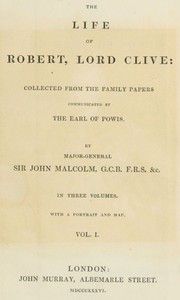
The Life of Robert, Lord Clive, Vol. 1 (of 3) by John Malcolm
Let's be honest, a three-volume biography from the 1800s about an 18th-century empire builder sounds like a chore. I was prepared for dense, fawning prose. John Malcolm's The Life of Robert, Lord Clive, Vol. 1 surprised me. It's surprisingly readable and brutally honest about its subject.
The Story
This volume covers Clive's life from his chaotic childhood up to his pivotal victory at the Battle of Arcot in 1751. We meet Robert Clive not as a hero, but as a problem child—restless, getting into fights, and seen as a disappointment. His early adulthood is marked by profound despair, including two suicide attempts. Seeking a fresh start, he ships off to Madras as a writer (a basic clerk) for the East India Company. He hates it. He's bored, sees no future, and clashes with his superiors. His life seems headed nowhere. Then, war breaks out between French and British trading companies. When the French capture Madras, Clive escapes and enlists as a soldier. Almost overnight, his natural talent for leadership and daring emerges. The book follows his rapid rise from volunteer to captain, culminating in his audacious, against-all-odds defense of Arcot, a move that turned the tide of the war and made his reputation.
Why You Should Read It
What grabbed me was the focus on Clive's character. Malcolm, who had access to Clive's family, doesn't shy away from the ugly parts. This isn't a statue coming to life; it's a portrait of a complex, volatile man. You see his courage, but also his pride and his deep-seated need to prove himself. The history feels immediate because it's filtered through this compelling personal struggle. The military scenes are tense and clear, but the real drama is psychological. Watching this lost young man find his purpose in the chaos of war is utterly fascinating, even when you're ambivalent about the imperial project he's advancing.
Final Verdict
Perfect for readers who enjoy character-driven biographies and origins stories, even in a historical setting. If you liked books like Chernow's Hamilton for its deep dive into a driven man's early years, you'll find similar themes here. It's also great for anyone interested in the 'how' of history—not just the dates, but the unpredictable human moments that change everything. Fair warning: this is just Part 1. It ends on a major victory, leaving you eager to see how fame and power change the man we've just watched claw his way up from the depths. A solid, engaging start to a monumental life story.
You are viewing a work that belongs to the global public domain. You do not need permission to reproduce this work.
Oliver Thomas
1 year agoSurprisingly enough, the arguments are well-supported by credible references. I couldn't put it down.
Daniel Davis
9 months agoTo be perfectly clear, the character development leaves a lasting impact. A true masterpiece.
Mark Brown
10 months agoTo be perfectly clear, the content flows smoothly from one chapter to the next. Exactly what I needed.
Noah Moore
1 year agoCitation worthy content.



Jackson Lopez
1 year agoHelped me clear up some confusion on the topic.