
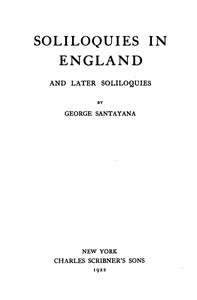
Soliloquies in England, and Later Soliloquies by George Santayana
Don't come to this book looking for a traditional story. George Santayana's 'Soliloquies in England' is a different kind of journey. It's a series of short, reflective essays—or 'soliloquies'—written between 1914 and 1918. The backdrop is immense: England is at war. Santayana, a Spanish-born philosopher who had taught at Harvard, was living there as a guest, watching a society he admired grapple with unimaginable conflict.
The Story
There's no plot in the usual sense. Instead, Santayana turns his gaze on everything around him. One moment he's describing the gentle, persistent English drizzle, the next he's pondering the nature of friendship or the ghosts of the past that haunt old buildings. The 'story' is the movement of his mind. He observes soldiers training, reflects on the genius of Dickens, critiques American optimism, and celebrates the deep, quiet charm of the English countryside. The book is structured by his wanderings—both physical walks and mental explorations—creating a portrait of a nation and a mind in a time of profound crisis.
Why You Should Read It
I love this book because it makes big ideas feel intimate. Santayana isn't lecturing from a podium. He's thinking out loud, and you get to listen in. His writing is clear, often witty, and packed with sudden, breathtaking insights. He'll be talking about clouds and then hit you with a line about the human soul that stops you cold. In an age of hot takes and quick opinions, this is slow, considered thought. It’s a masterclass in observation. He shows how paying deep attention to the world—a cobblestone street, a friend's character, a feeling of nostalgia—is itself a philosophical act. It changed how I look at my own daily surroundings.
Final Verdict
This book is perfect for thoughtful readers who enjoy essays, philosophy that isn't stuffy, or rich, descriptive prose. It's for anyone who likes the works of Montaigne or Emerson, or for fans of quiet, observational writers like Henry David Thoreau. If you're a history enthusiast curious about the intellectual mood of World War I England, seen through a brilliant outsider's eyes, you'll find it fascinating. It's not a fast read; it's a book to sip slowly, maybe just one soliloquy with your morning coffee. Give it to the friend who always points out interesting details on a walk and loves a good, meandering conversation about life.
This publication is available for unrestricted use. It is available for public use and education.
Aiden Harris
1 year agoI didn't expect much, but the emotional weight of the story is balanced perfectly. This story will stay with me.
Ashley Gonzalez
6 months agoI didn't expect much, but it creates a vivid world that you simply do not want to leave. A valuable addition to my collection.




Susan Moore
1 year agoHaving read the author's previous works, the way the author breaks down the core concepts is remarkably clear. Finally, a source that prioritizes accuracy over hype.