About 214 minutes
Aids to Forensic Medicine and Toxicology — Context and Discussion
Fantasy Juvenile Worlds
49,122 recorded words. 45 minutes difference from this book's estimate.
View Gutenberg source #19019
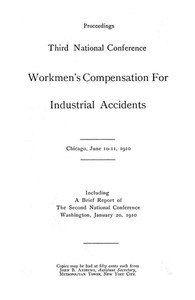
Before opening Proceedings, Third National Conference Workmen's Compensation for Industrial Accidents — Themes and Context, the edition data offers a quick orientation: 59,542 words, 4 hr 19 min estimated reading time, and 6 detected text sections.
The text analysis averages about 26.6 words per sentence, while the detected sections provide another way to judge how the source is divided.
Project Gutenberg metadata also associates the work with “Accident insurance,” connecting these edition facts with the source record’s subject description.
Explore this collection
These alternatives are selected using recorded categories and estimated reading time.
About 214 minutes
Fantasy Juvenile Worlds
49,122 recorded words. 45 minutes difference from this book's estimate.
View Gutenberg source #19019About 312 minutes
Fantasy Juvenile Worlds
71,751 recorded words. 53 minutes difference from this book's estimate.
View Gutenberg source #36591About 156 minutes
Fantasy Juvenile Worlds
35,779 recorded words. 103 minutes difference from this book's estimate.
View Gutenberg source #69710Search stored excerpts and compare books → Choose by your preferences →
Choices use stored catalog measurements. Estimates vary with reading speed. A shared category is a catalog label, not a claim that two books have the same argument or literary quality.
Search reads excerpt text stored with this catalog and links to its associated Gutenberg record. The connection is stored in the site database; this tool does not recheck that every excerpt is word-for-word identical to that external record. Excerpt search does not cover every chapter and does not verify historical publication dates.
Catalog snapshot checked: 2026-09-25. Coverage: 90 public books, 90 available source excerpts.
Calculated from edition completeness, EPUB availability, text structure and catalogue metadata. Not a user rating.
Total of 100 points, scaled to a 2.5-5.0 range. Editions with an empty description or a missing EPUB file are not scored.
Public-domain source text
The source text is kept in the dedicated reader, separate from this catalogue record and its commentary.
The proceedings open with a pointed exchange between Wallace Ingalls of Wisconsin and other delegates over the constitutionality of compulsory compensation. Ingalls argues that the proposed bill, by characterizing all occupations as dangerous, invokes police power and risks overriding individual rights—a principle he insists distinguishes the U.S. from Germany and England. This tension between reform and legal tradition recurs throughout the record.
Speakers frequently frame the compensation question in terms of moral hazard. One delegate notes that employers at a prior Minneapolis meeting argued that increased liability would make employees careless. The response is telling: the same speaker observes that accident reports rise under compensation because workmen report better, and that dangerous high-speed machinery, not worker negligence, drives non-serious accidents. A German insurance company's data is cited to show trivial accidents up, fatal ones down, and employers penalized for negligence. The language here—'penalized,' 'careless,' 'protecting the lives'—reveals a rhetorical struggle between attributing risk to worker behavior versus industrial conditions.
Wallace Ingalls repeatedly invokes 'individual rights' as a foundational American principle, contrasting it with European systems where such rights are absent. He warns against 'invading individual rights' by forcing workers to accept fixed compensation without a day in court. This is not merely a legal point; it shapes the conference's structure. The Wisconsin plan, which Ingalls helped craft, makes compensation 'optional' while destroying employer defenses—a compromise that preserves the rhetoric of choice. The proceedings thus record a deliberate effort to reconcile reform with constitutional language.
The conference includes a 'Workers' Compensation Code' outline for discussion, suggesting a move toward model legislation. The outline's structure—sections on scope, benefits, and administration—reflects an attempt to standardize state laws. Yet the debate reveals disagreement: some delegates push for compulsory systems, others for voluntary ones. The outline itself becomes a tool for negotiation, its headings framing what is negotiable. The proceedings thus document not just opinions but the procedural mechanics of policy-making, where the shape of a document influences the outcome.
The setting—Chicago, June 1910, with officers from state commissions and universities—gives the record a bureaucratic yet urgent tone. Speakers identify themselves by state and role (e.g., 'Wallace Ingalls (Wisconsin)'), grounding arguments in local experience. The secretary's note that copies cost fifty cents from John B. Andrews in New York underscores the conference's practical, networking function. The voice is formal but not dry; interruptions and direct addresses ('you will pardon me for any criticism') suggest a live, contentious atmosphere. This is not a polished treatise but a transcript of people wrestling with policy in real time.
Readers should approach this text as a primary source on early 20th-century labor policy, noting how speakers balance reform with legal tradition. The excerpts offer a window into the language of compromise—where 'individual rights' and 'compulsory compensation' are negotiated, not resolved. Pay attention to who speaks and from which state; the record is as much about political geography as about ideas.
These old proceedings—debates on duty, liability, the weight of a working life—remind me of how law tries to hold what water cannot. Both volumes share that patient hush of men arguing over edges, over who owes whom. I often shelve them near each other, two quiet companions in the stacks. The law of the sea — Reading Notes whispers of other boundaries, equally stubborn. A shared ache, really.
Create a short personal record of your experience with this book.