About 942 minutes
Copyright: Its History and Its Law — Context and Discussion
Historical Psychological Social Fiction
216,594 recorded words. 72 minutes difference from this book's estimate.
View Gutenberg source #39502
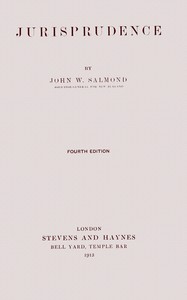
This digital edition of Jurisprudence — Reading Notes is described by source-level measurements including 200,012 words, 14 hr 30 min estimated reading time, and 40 detected text sections.
The text analysis averages about 19.7 words per sentence, while the detected sections provide another way to judge how the source is divided.
Project Gutenberg metadata also associates the work with “Jurisprudence,” connecting these edition facts with the source record’s subject description.
Explore this collection
These alternatives are selected using recorded categories and estimated reading time.
About 942 minutes
Historical Psychological Social Fiction
216,594 recorded words. 72 minutes difference from this book's estimate.
View Gutenberg source #39502About 723 minutes
Historical Psychological Social Fiction
166,195 recorded words. 147 minutes difference from this book's estimate.
View Gutenberg source #52264About 715 minutes
Historical Psychological Social Fiction
164,378 recorded words. 155 minutes difference from this book's estimate.
View Gutenberg source #64926Search stored excerpts and compare books → Choose by your preferences →
Choices use stored catalog measurements. Estimates vary with reading speed. A shared category is a catalog label, not a claim that two books have the same argument or literary quality.
Search reads excerpt text stored with this catalog and links to its associated Gutenberg record. The connection is stored in the site database; this tool does not recheck that every excerpt is word-for-word identical to that external record. Excerpt search does not cover every chapter and does not verify historical publication dates.
Catalog snapshot checked: 2026-09-25. Coverage: 90 public books, 90 available source excerpts.
Calculated from edition completeness, EPUB availability, text structure and catalogue metadata. Not a user rating.
Total of 100 points, scaled to a 2.5-5.0 range. Editions with an empty description or a missing EPUB file are not scored.
Public-domain source text
The source text is kept in the dedicated reader, separate from this catalogue record and its commentary.
Salmond opens his treatise by distinguishing jurisprudence as the science of civil law, setting it apart from other forms of legal inquiry. He writes primarily for students seeking a scientific foundation for legal education, but also addresses lawyers and laymen interested in the theoretical aspects of law. The preface reveals his intent to make the work accessible beyond technical legal circles, noting that portions in smaller type are of lesser importance or controversial nature. The text's structure, with numbered sections and chapters, reflects a systematic approach to legal theory.
Salmond defines jurisprudence as the science of civil law, emphasizing its theoretical rather than practical character. He distinguishes it from other kinds of law, such as physical or scientific law, and argues that jurisprudence is logically subsequent to the administration of justice. The text proceeds methodically, with each chapter building on previous concepts. Salmond's voice is precise and authoritative, using terms like 'repellent mysteries' to describe the law's technicalities. He acknowledges the defects of law while justifying its necessity, creating a balanced tone that invites critical engagement.
In a detailed passage on collective ownership, Salmond explains how the law uses trusteeship and incorporation to manage property held by multiple persons. He describes trusteeship as a mode of overcoming difficulties created by 'incapacity, uncertainty, or multiplicity' of owners. Incorporation, he argues, is a development of trusteeship, allowing a fictitious entity to serve as a permanent unity. Salmond notes that a fictitious trustee is 'exempt from the inevitable mortality that afflicts mankind,' a striking phrase that underscores the theoretical appeal of corporate personhood. He also discusses limited liability as a modern purpose of incorporation, enabling traders to avoid risking their whole fortune.
The text's pace varies between dense theoretical exposition and more accessible explanatory passages. Salmond uses smaller type for less essential or controversial material, creating a layered reading experience. His sentences are often long and complex, reflecting the intricacy of legal concepts. The argument proceeds by logical steps, with each section addressing a specific aspect of jurisprudence. For example, the discussion of incorporation moves from general purpose to specific applications, such as limited liability. This structured approach helps readers navigate the 200,000-word work, though the density of language may require careful attention.
Readers approaching this work should be prepared for a systematic, theoretical exploration of legal foundations. Salmond's prose rewards patience, as his arguments unfold through careful distinctions and examples. The text's division into numbered sections and the use of smaller type for secondary material provide useful navigation aids. Those interested in the evolution of legal concepts, particularly around corporate personhood and collective ownership, will find relevant discussions embedded within the broader theoretical framework.
Salmond’s careful parsing of law’s foundations—those quiet rules of trusteeship—always felt like a hand steadying the scale. It reminded me of reading the Border guard notes years later, where the same tension between duty and discretion hums underneath ordinary moments. Some books just linger, not because they answer, but because they ask so gently. Border guard — Context and Discussion sits on my shelf like an old friend’s marginalia.
Capture what you thought, learned, and would like to remember.