
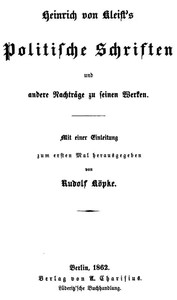
Heinrich von Kleist's politische Schriften und andere Nachträge zu seinen…
This book isn't a novel with a plot in the usual sense. Instead, it collects the political essays, journalism, and scattered notes of Heinrich von Kleist, written mostly between 1809 and 1811. The 'story' here is the story of a mind on fire during a time of crisis. Kleist watches Napoleon's armies dominate Europe and sees the German states humiliated and divided. His writing becomes a weapon. He publishes fiery nationalist essays calling for resistance, edits a short-lived political newspaper meant to stir public opinion, and grapples with ideas about patriotism, sacrifice, and how a people can reclaim their dignity. The collection also includes various literary fragments and later additions found among his papers, offering glimpses into projects he never finished. The central narrative arc is Kleist's own transformation from a playwright into a political agitator, driven by a sense of urgent, desperate purpose.
Why You Should Read It
You should read this to meet a different Kleist. We often know him as the master of psychological turmoil in plays like Penthesilea or The Marquise of O.... Here, that same intense, almost chaotic energy is directed at the real world. His political writing isn't calm or academic. It's visceral. You can feel his frustration, his hope, and his profound fear for the future of his culture. What's amazing is how modern some of his concerns feel—questions about national identity, media manipulation (his newspaper was early propaganda), and the individual's role in a political struggle. It adds a crucial layer to understanding why his literary works are so full of conflict and broken characters. The man writing these essays was living in a broken world.
Final Verdict
This book is perfect for readers who love history, but want to experience it through the eyes of a brilliant, emotional artist rather than a historian. It's also essential for anyone interested in Kleist, as it completes the picture of who he was. Be warned: it's not a light read. The ideas are dense and the context is specific. But if you're willing to sit with it, you'll be rewarded with a stunningly personal document from a pivotal moment in European history, written by a true literary firebrand. Think of it as the passionate, opinionated blog of a 19th-century genius.
This masterpiece is free from copyright limitations. Knowledge should be free and accessible.
James Jones
1 year agoAs a long-time follower of this subject matter, the transition between theoretical knowledge and practical application is seamless. An excellent example of how quality digital books should be formatted.
Susan Perez
2 months agoFrom the very first page, the author's voice is distinct and makes complex topics easy to digest. Thanks for sharing this review.
Mary Hernandez
10 months agoThe digital formatting makes it very easy to navigate.