
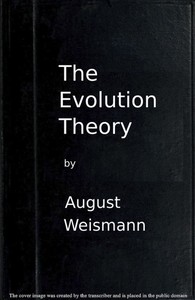
The Evolution Theory, Vol. 1 of 2 by August Weismann
Let's set the scene. It's the late 1800s. Charles Darwin's On the Origin of Species has shaken the world, but it left a gigantic question unanswered: How does inheritance actually work? Everyone agrees life evolves, but the 'how' is a murky mystery filled with strange guesses. Enter August Weismann, a German biologist who decides to cut through the fog with pure, relentless logic.
The Story
This isn't a story with characters in the usual sense. The protagonist is Weismann's own reasoning, and the villain is a widespread, comforting misconception called 'the inheritance of acquired characteristics.' People believed that if you worked hard and built strong muscles, your kids could inherit that strength. Weismann said no. He conducted famous thought experiments (like cutting the tails off mice for generations) to prove this idea wrong. His real plot twist is the introduction of the 'germ-plasm' theory. He argued that only a special line of cells in our bodies—the germ cells that become eggs and sperm—are responsible for heredity. These cells, he said, are sealed off and protected from the wear and tear of our daily lives. The body you live in is just a temporary vehicle; the immortal genetic information travels through it to the next generation. This volume is him building that case, brick by logical brick, separating the fate of the body from the fate of the genetic line.
Why You Should Read It
You should read this to feel the electricity of a foundational scientific idea being born. It's humbling and exciting. Weismann had no way to see DNA, no modern lab equipment. He used observation, criticism of flawed experiments, and brilliant deduction to point directly at the truth. Reading his arguments is like watching a master chess player think ten moves ahead. You get a real sense of how science corrects itself. It also makes you appreciate our modern knowledge. Every time you hear the word 'gene,' you can trace it back to Weismann's stubborn insistence that there had to be a physical, protected carrier of information.
Final Verdict
This book is perfect for curious readers who love the history of ideas. It's for the person who enjoys a good mental puzzle and wants to understand not just what we know, but how we came to know it. It's not a light beach read—you have to meet Weismann halfway and follow his logic—but the reward is immense. You'll finish it looking at every living thing, including yourself, in a slightly different way. If you've ever wondered about the real origins of genetics, this is where the story truly begins.
This text is dedicated to the public domain. You do not need permission to reproduce this work.
Emma Martinez
8 months agoAfter hearing about this author multiple times, the pacing is just right, keeping you engaged. Highly recommended.
Matthew Johnson
7 months agoI started reading out of curiosity and the narrative structure is incredibly compelling. Exceeded all my expectations.
Mark Davis
1 year agoAs someone who reads a lot, the clarity of the writing makes this accessible. Thanks for sharing this review.
John Moore
1 year agoCitation worthy content.
Sarah Johnson
1 year agoThe clarity of the concluding remarks is very professional.