About 461 minutes
The American Judiciary — Key Ideas to Explore
Historical Psychological Social Fiction
106,029 recorded words. 1 minutes difference from this book's estimate.
View Gutenberg source #8691
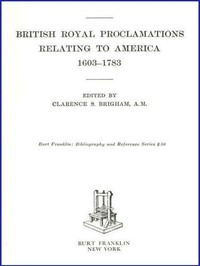
This digital edition of British Royal Proclamations Relating to America, 1603-1783 — Themes and Context is described by source-level measurements including 105,761 words, 7 hr 40 min estimated reading time, and 16 detected text sections.
The text analysis averages about 38.7 words per sentence, while the detected sections provide another way to judge how the source is divided.
Project Gutenberg metadata also associates the work with “United States -- History -- Colonial period, ca. 1600-1775 -- Sources,” connecting these edition facts with the source record’s subject description.
Explore this collection
These alternatives are selected using recorded categories and estimated reading time.
About 461 minutes
Historical Psychological Social Fiction
106,029 recorded words. 1 minutes difference from this book's estimate.
View Gutenberg source #8691About 474 minutes
Historical Psychological Social Fiction
108,927 recorded words. 14 minutes difference from this book's estimate.
View Gutenberg source #72689About 499 minutes
Historical Psychological Social Fiction
114,687 recorded words. 39 minutes difference from this book's estimate.
View Gutenberg source #41759Search stored excerpts and compare books → Choose by your preferences →
Choices use stored catalog measurements. Estimates vary with reading speed. A shared category is a catalog label, not a claim that two books have the same argument or literary quality.
Search reads excerpt text stored with this catalog and links to its associated Gutenberg record. The connection is stored in the site database; this tool does not recheck that every excerpt is word-for-word identical to that external record. Excerpt search does not cover every chapter and does not verify historical publication dates.
Catalog snapshot checked: 2026-09-25. Coverage: 90 public books, 90 available source excerpts.
Calculated from edition completeness, EPUB availability, text structure and catalogue metadata. Not a user rating.
Total of 100 points, scaled to a 2.5-5.0 range. Editions with an empty description or a missing EPUB file are not scored.
Public-domain source text
The source text is kept in the dedicated reader, separate from this catalogue record and its commentary.
Clarence S. Brigham's 1911 collection of British royal proclamations relating to America from 1603 to 1783 is a work of careful editorial selection. Brigham explicitly limits the volume to proclamations that "emanated directly from the King," excluding those issued by provincial governors or colonial officials. This choice shapes the reader's encounter with a specific register of royal authority—one that is formal, legalistic, and often punitive.
The proclamations themselves reveal a consistent rhetorical structure: they begin with a statement of royal prerogative, detail the offense or situation, declare the Crown's response, and conclude with commands or offers of pardon. The language is marked by repetition of phrases like "His Majesty doth hereby" and "strictly Charge and Command," creating a rhythm of sovereign decree.
Brigham's introduction makes clear that the volume is a deliberate narrowing of a vast documentary field. He notes that colonial proclamations "exist in such profusion as to be quite beyond the scope of this volume" and that they are "practically never entered in the English records." This editorial decision foregrounds the Crown's voice over local administrative noise. By limiting the collection to royal proclamations, Brigham creates a coherent corpus that allows readers to trace the evolution of imperial language over 180 years. The editor also excludes orders in council, which were often only in manuscript, further sharpening the focus on publicly proclaimed royal will.
The proclamations employ a formal, repetitive diction that reinforces royal authority. In the 1676 proclamation against Nathaniel Bacon, the Crown declares Bacon and his followers "guilty of the crime of High Treason" and offers a reward of "Three Hundred Pounds Sterling" for his apprehension. Yet the same document includes a clause of pardon for those who submit within twenty days, using the phrase "His Majesty out of His Royal Pity and Compassion." This juxtaposition of threat and clemency is a recurring pattern: the Crown asserts absolute power while simultaneously offering a path to forgiveness, a rhetorical move that underscores both sovereignty and paternalism.
Each proclamation follows a predictable structure: a preamble stating the king's authority, a narrative of the grievance or event, the declaration of royal action, and a concluding command or offer. For example, the Bacon proclamation begins by recounting the rebellion, then declares Bacon a traitor, offers a reward, and finally extends pardon to those who submit. This formulaic structure serves to standardize royal communication across diverse colonial contexts. The repetition of phrases like "His Majesty doth hereby Publish and Declare" and "strictly Charge and Command" creates a ritualistic tone, emphasizing that the king's word is law.
The proclamations are addressed to "all His Loving Subjects," a phrase that simultaneously asserts the king's affection and his expectation of obedience. The language is designed to be both authoritative and persuasive, offering rewards for compliance and threatening punishment for defiance. In the Bacon proclamation, the Crown even promises liberty to servants or slaves who abandon the rebels and take up arms for the governor—a strategic use of social division to undermine rebellion. This rhetorical awareness suggests that the proclamations were crafted not merely as legal documents but as instruments of political communication aimed at shaping colonial behavior.
Readers approaching this collection should attend to the editorial framing as much as to the proclamations themselves. Brigham's choices—what to include, what to exclude, how to organize—shape the narrative of imperial authority. The proclamations are best read as performances of sovereignty, where diction and structure are as revealing as content. By focusing on the language of command and mercy, one can discern the Crown's evolving strategies for governing distant colonies.
There’s something touching about how Brigham’s proclamations preserve the Crown’s formal distance, each edict a small monument to control. It makes me think of those early California sketches, where the same imperial voice meets the messy, intimate reality of settlers’ lives. That gap—between official record and lived memory—feels like the quiet space where history actually breathes. Personal reminiscences of early days in California, with other sketches — Context and Discussion lingers there, too.
Capture what you thought, learned, and would like to remember.