A collection of Latin maxims & rules, in law and equity — Reading Notes

(0 User reviews)   276
Halkerston, Peter, -1833? Project Gutenberg 2023 Not confirmed
Legal maxims Readers of public-domain and historical texts
Project Gutenberg digital edition en

Edition facts

Words 36,980
Reading time 161 min
Text sections 26

A collection of Latin maxims & rules, in law and equity — Reading Notes can be approached with a clearer sense of reading commitment from its source measurements: 36,980 words, 2 hr 41 min estimated reading time, and 26 detected text sections.

The text analysis averages about 11.2 words per sentence, while the detected sections provide another way to judge how the source is divided.

Project Gutenberg metadata also associates the work with “Legal maxims,” connecting these edition facts with the source record’s subject description.

Explore this collection

Compare your next read

These alternatives are selected using recorded categories and estimated reading time.

Search stored excerpts and compare books → Choose by your preferences →

How these choices and excerpts are prepared

Choices use stored catalog measurements. Estimates vary with reading speed. A shared category is a catalog label, not a claim that two books have the same argument or literary quality.

Search reads excerpt text stored with this catalog and links to its associated Gutenberg record. The connection is stored in the site database; this tool does not recheck that every excerpt is word-for-word identical to that external record. Excerpt search does not cover every chapter and does not verify historical publication dates.

Catalog snapshot checked: 2026-09-25. Coverage: 90 public books, 90 available source excerpts.

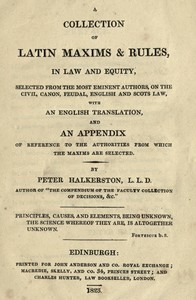
Peter Halkerston's 1823 compilation of Latin legal maxims from civil, canon, feudal, English, and Scots law, with English translations and an appendix of authorities. The preface frames maxims as 'pillars' of legal systems, while the entries reveal tensions between rigid rules and equitable interpretation, public duty and private right, and presumption versus proof.
Share
Editorial Edition Score 4.8/5

Calculated from edition completeness, EPUB availability, text structure and catalogue metadata. Not a user rating.

How this score is calculated
  • Description quality20 pts
  • Title & short description10 pts
  • Source metadata20 pts
  • Text length15 pts
  • Chapters / structure15 pts
  • EPUB file integrity20 pts

Total of 100 points, scaled to a 2.5-5.0 range. Editions with an empty description or a missing EPUB file are not scored.

Edition quality

Public-domain source text

Read the source text

The source text is kept in the dedicated reader, separate from this catalogue record and its commentary.

Peter Halkerston's 1823 collection assembles Latin legal maxims drawn from civil, canon, feudal, English, and Scots law, each accompanied by an English translation and an appendix citing authorities. The preface declares that maxims are 'the pillars upon which the system is erected,' yet the entries themselves repeatedly qualify their own authority. A rule, Halkerston notes, 'must be applied duly to the proper cases; for otherwise it loses its force.' This tension between fixed principle and flexible application runs through the work.

The maxims cover procedure, evidence, property, crime, and equity. Recurring concerns include the limits of presumption, the weight of intention, and the balance between public good and private rights. The collection offers a window into early nineteenth-century legal reasoning, where Latin aphorisms served as shorthand for complex doctrines.

Presumption and Its Limits

Several maxims address what the law may assume in the absence of contrary proof. 'All things are presumed lawfully done, until it be proved to the contrary' appears alongside 'All things are presumed in hatred of the spoiler.' These presumptions are not absolute: 'Odious and dishonourable things are not to be presumed in law.' The compiler includes a maxim that 'every uncondemned person is reckoned as innocent by the laws,' grounding a core principle in a Latin phrase. Yet another entry warns that 'every definition in the civil law is dangerous, for there is a chance of its being overturned.' The collection thus presents presumption as a tool with clear boundaries, subject to rebuttal and vulnerable to exception.

Intention, Action, and Moral Judgment

A cluster of maxims ties legal consequences to the actor's state of mind. 'Every action is to be judged from the intention of the agent' appears alongside observations on drunkenness, which 'both inflames, detects, and aggravates every crime.' The moral dimension is explicit: 'The good hate to sin, from a love of virtue. The wicked hate to sin, from a fear of punishment.' Halkerston includes maxims on consent ('All consent takes away error') and on disgraceful contracts ('Every disgraceful contract is odious to the laws'). These entries suggest a legal system attentive to motive and moral character, even as they reduce complex judgments to concise formulas.

Public Duty, Private Right, and Temporal Limits

Several maxims define the relationship between individual obligations and the state. 'All subjects are bound to defend the republic with their life and all their goods' sits alongside 'Duty ought to be hurtful to none.' The collection also addresses temporal boundaries: 'Every law and every action is finished and circumscribed by the time of the injury,' and 'Every new constitution ought to impose a form on future times, not on past times.' Property and marital rights appear in maxims stating that a wife's goods belong to her husband during marriage. These entries reveal a legal order that balances communal defense with individual protection, while insisting on temporal limits to liability and legislative change.

Readers should approach this collection as a reference work shaped by its compiler's selections and translations. Halkerston acknowledges his translation 'is not in every respect perfect,' and the maxims often omit the case law from which they were distilled. The appendix of authorities offers a path to the original sources. For those studying legal history, the volume captures how early nineteenth-century jurists condensed doctrine into memorable Latin phrases, preserving tensions between rule and exception that remain central to legal reasoning.

There’s something tender about old law books, how they assume the world will hold still long enough for a rule to matter. Reading Halkerston’s maxims, I kept thinking how the mind itself must be the hardest equity to measure — which is why I lingered over A Letter to the Right Honorable the Lord Chancellor, on the Nature and Interpretation of Unsoundness of Mind, and Imbecility of Intellect — Key Ideas to Explore, a quieter plea for mercy in judgment.

There are no reviews for this eBook.

0
0 out of 5 (0 User reviews )

Add a Review

Your Rating *
There are no comments for this eBook.

Reader reflection

Take a moment to reflect on this book

Create a short personal record of your experience with this book.

Your progress 0 / 10
1

How far have you progressed with this book?

2

Was reading this book enjoyable?

3

Would you encourage someone else to read it?

4

How much effort did this book require?

Related eBooks