About 882 minutes
The Life of John Marshall, Volume 4: The building of the nation, 1815-1835 — A Reader’s Guide
Fantasy Juvenile Worlds
202,658 recorded words. 72 minutes difference from this book's estimate.
View Gutenberg source #40533
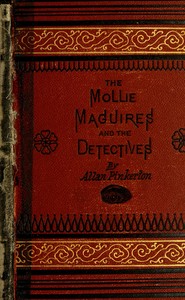
Before opening The Molly Maguires and the detectives — A Reader’s Guide, the edition data offers a quick orientation: 186,135 words, 13 hr 30 min estimated reading time, and 53 detected text sections.
The text analysis averages about 22.8 words per sentence, while the detected sections provide another way to judge how the source is divided.
Project Gutenberg metadata also associates the work with “Secret societies,” connecting these edition facts with the source record’s subject description.
Explore this collection
These alternatives are selected using recorded categories and estimated reading time.
About 882 minutes
Fantasy Juvenile Worlds
202,658 recorded words. 72 minutes difference from this book's estimate.
View Gutenberg source #40533About 683 minutes
Fantasy Juvenile Worlds
156,899 recorded words. 127 minutes difference from this book's estimate.
View Gutenberg source #41095About 668 minutes
Fantasy Juvenile Worlds
153,522 recorded words. 142 minutes difference from this book's estimate.
View Gutenberg source #7126Search stored excerpts and compare books → Choose by your preferences →
Choices use stored catalog measurements. Estimates vary with reading speed. A shared category is a catalog label, not a claim that two books have the same argument or literary quality.
Search reads excerpt text stored with this catalog and links to its associated Gutenberg record. The connection is stored in the site database; this tool does not recheck that every excerpt is word-for-word identical to that external record. Excerpt search does not cover every chapter and does not verify historical publication dates.
Catalog snapshot checked: 2026-09-25. Coverage: 90 public books, 90 available source excerpts.
Calculated from edition completeness, EPUB availability, text structure and catalogue metadata. Not a user rating.
Total of 100 points, scaled to a 2.5-5.0 range. Editions with an empty description or a missing EPUB file are not scored.
Public-domain source text
The source text is kept in the dedicated reader, separate from this catalogue record and its commentary.
The opening pages of The Molly Maguires and the Detectives announce themselves as the sixth volume of Allan Pinkerton's detective series, a subscription book sold by canvassers. The title page and contents list forty-three chapters with headings like “An Extraordinary Proposition” and “The Detective Sings, Fights, and Dances Himself into Popularity.” The reader is immediately placed in a world where the author is both narrator and agency principal, and where the operative Jim McKenna—a thinly disguised James McParlan—must adopt a persona of reckless Irish bravado to penetrate the secret society.
The early excerpts show Pinkerton foregrounding the detective’s method. In a conversation at Jack Kehoe’s hotel, McKenna feigns bashfulness about courting Pat Hester’s daughter, using the pretext to draw out the drunken Donahue. The narrator notes that “everything depended upon a good commencement,” and McKenna’s strategy is to appear harmless while steering talk toward crimes. Donahue’s line “An’ is it yourself that ye are, or some cruddy gorsoon” reveals the dialect Pinkerton reproduces throughout, marking class and ethnicity. The detective’s counter—feigning absorption in romance while “noting in his mind the most trivial incident”—establishes the core tension: the operative must play a part while recording evidence.
Pinkerton’s prose relies heavily on transcribed speech. Donahue’s boastful, drink-fueled confessions—“out came the fact of the recent burnin”—are rendered in phonetic spelling (“phat,” “axin’,” “cruddy gorsoon”). The detective’s own dialogue shifts between stage Irish and calculated restraint. This technique serves two purposes: it authenticates the setting for contemporary readers, and it lets Pinkerton report criminal details without authorial commentary. The excerpts show that the narrative advances less through action than through talk—McKenna pumps his mark by pretending to deflect. The reader must attend to who speaks, how, and what slips out between drinks.
The contents list offers a roadmap of escalating danger. Early chapters like “The Detective seeks the Haunts of the Mollies” and “Stirring up a Wasp’s Nest” promise infiltration, while later ones—“Bloody Record of the Mollie Maguires,” “A Kilkenny Affair at Tamaqua”—signal violence. The headings themselves are mini-spoilers, yet they also create expectation: the reader knows McKenna will sing, fight, and dance his way into favor, but not how each ruse will unfold. The excerpt from Chapter XII, “McKenna meets a Morning Adventure,” suggests episodic structure, with each chapter delivering a set piece of danger or discovery. This serialized rhythm suits the subscription format, rewarding readers who follow installment by installment.
The provided passages break off before the trial at Mauch Chunk mentioned in the frontispiece, and before the detective’s eventual exposure or escape. We see only the early stages of infiltration: the recruitment of Donahue as informant, the feigned courtship, and the first pumped confessions. The later excerpts are missing, so we cannot assess how Pinkerton handles the climax or the legal aftermath. The catalog subjects—Anthracite Coal Strike, 1875; secret societies; Irish in Pennsylvania—indicate the historical context, but the excerpts do not confirm whether Pinkerton includes documentary evidence, trial transcripts, or editorial commentary. A first reader should note that the narrative is filtered entirely through the detective agency’s perspective, with the Mollies’ motives inferred from their own incriminating words.
Because the excerpts concentrate on the opening moves, a first reading benefits from paying close attention to the chapter headings as a guide to pacing. Pinkerton’s method is cumulative: each drinking session, each feigned courtship, each scrap of dialect builds a case. The reader who tracks who says what—and when the detective stops pretending to resist—will see the architecture of a sting operation rendered as popular entertainment. The book rewards patience with its vernacular texture and its slow, deliberate construction of evidence.
There’s something haunting about McParlan’s drinking with those men, earning trust while building a case against them. It makes me wonder about what gets enclosed when we turn lived experience into usable evidence, which is why The Public Domain: Enclosing the Commons of the Mind — Reading Notes felt like a quiet echo of that same loss.
Capture what you thought, learned, and would like to remember.