About 317 minutes
Criminal Man, According to the Classification of Cesare Lombroso — Edition Insights
Historical Psychological Social Fiction
72,815 recorded words. 40 minutes difference from this book's estimate.
View Gutenberg source #29895
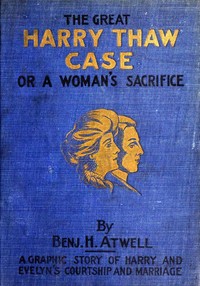
The catalog record for The Great Harry Thaw Case; Or, A Woman's Sacrifice — Background and Themes provides practical reading context through 63,683 words, 4 hr 37 min estimated reading time, and 9 detected text sections.
The text analysis averages about 17.0 words per sentence, while the detected sections provide another way to judge how the source is divided.
Project Gutenberg metadata also associates the work with “Thaw, Harry Kendall, 1871-1947 -- Trials, litigation, etc.,” connecting these edition facts with the source record’s subject description.
Explore this collection
These alternatives are selected using recorded categories and estimated reading time.
About 317 minutes
Historical Psychological Social Fiction
72,815 recorded words. 40 minutes difference from this book's estimate.
View Gutenberg source #29895About 223 minutes
Historical Psychological Social Fiction
51,191 recorded words. 54 minutes difference from this book's estimate.
View Gutenberg source #50124About 188 minutes
Historical Psychological Social Fiction
43,120 recorded words. 89 minutes difference from this book's estimate.
View Gutenberg source #54086Search stored excerpts and compare books → Choose by your preferences →
Choices use stored catalog measurements. Estimates vary with reading speed. A shared category is a catalog label, not a claim that two books have the same argument or literary quality.
Search reads excerpt text stored with this catalog and links to its associated Gutenberg record. The connection is stored in the site database; this tool does not recheck that every excerpt is word-for-word identical to that external record. Excerpt search does not cover every chapter and does not verify historical publication dates.
Catalog snapshot checked: 2026-09-25. Coverage: 90 public books, 90 available source excerpts.
Calculated from edition completeness, EPUB availability, text structure and catalogue metadata. Not a user rating.
Total of 100 points, scaled to a 2.5-5.0 range. Editions with an empty description or a missing EPUB file are not scored.
Public-domain source text
The source text is kept in the dedicated reader, separate from this catalogue record and its commentary.
Benj. H. Atwell's The Great Harry Thaw Case; Or, A Woman's Sacrifice (1907) opens not with a novelist's scene-setting but with a table comparing jury deliberation times, immediately establishing the work as a hybrid of journalism and legal commentary. The subtitle, 'A Woman's Sacrifice,' signals a framing that will recur throughout: Evelyn Nesbit is presented less as a witness than as a figure of tragic choice. Atwell's prose in the excerpts alternates between courtroom transcript and editorial gloss, a stylistic decision that shapes how the reader encounters the case.
Atwell's word choices reveal a deliberate effort to cast the principals in moral roles. The district attorney, William Travers Jerome, is given speeches that employ elevated, almost literary language: he speaks of 'the heroic sacrifice made by Evelyn Nesbit' and refers to 'the crux of the case as it appears in the evidence.' This diction elevates the legal argument into a narrative of virtue and villainy. By contrast, the defense attorney Delmas is described as 'The Napoleon of the Bar,' a label that reduces a complex legal strategist to a single, martial epithet. Such choices suggest Atwell is less interested in neutral reportage than in shaping reader sympathy.
The excerpts contain extended passages of direct speech from the trial, but Atwell does not simply transcribe; he selects and arranges. Jerome's impassioned plea to the judge—'If I can show that Mrs. Thaw did not tell Thaw in Paris that White drugged her'—is rendered as a dramatic monologue, complete with rhetorical repetition ('If I can show... If I can show...'). This is not raw testimony but a crafted set piece. The effect is to make the reader feel present in the courtroom, yet aware that the author is curating the drama. Atwell also includes moments of legal obstruction—'Mr. Delmas was on his feet to object'—which inject tension into what might otherwise be dry procedural exchange.
Though the excerpts are dominated by dialogue, Atwell inserts brief descriptive cues that anchor the narrative in place. The front matter includes an illustration caption: 'MADISON SQUARE GARDEN The Scene of the Thaw-White Tragedy' and 'THE TOMBS PRISON Window in Circle Marks Thaw’s Cell.' These captions, though not part of the prose narrative, indicate a visual imagination at work. Within the text, description is sparse but pointed: the courtroom is not described in detail, but the reader is told of 'the district attorney made an impassioned argument,' which implies a physical performance. Atwell trusts the reader to fill in the scene, focusing instead on the psychological drama.
The book's structure—a chronology, then chapters with titles like 'Evelyn Nesbit Thaw, the Woman in the Case' and 'Greatest Legal Battle of the Age Opens'—suggests a narrative arc that moves from character introduction to climax. Yet the excerpts show that Atwell frequently interrupts the story with legal analysis, such as the jury-verdict table. This structural choice positions the reader as both spectator and juror, asked to weigh evidence while being guided by the author's framing. The repeated use of 'the woman in the case' and 'a woman's sacrifice' in chapter titles reinforces a gendered lens that may color how the reader interprets Evelyn Nesbit's testimony.
Readers approaching The Great Harry Thaw Case should attend to how Atwell blends reportage with editorial shaping. The work is not a neutral transcript but a constructed narrative that uses diction, dialogue selection, and structural cues to guide interpretation. Noting where the author inserts his own voice—through epithets, dramatic punctuation, or chapter titles—can reveal the persuasive strategies at work beneath the surface of 'graphic and truthful narrative.'
I’ve often shelved the old Thaw case accounts, their courtroom clamor still loud between the pages. Yet among them, that quiet note on authorial choice feels like a whispered aside. It reminds me of how laws, too, once had their storytellers. There’s a hush in that old Roman text, a hand reaching across centuries. The Twelve Tables — Edition Insights holds that same careful breath, listening for the voice beneath the carved words.
Capture what you thought, learned, and would like to remember.