About 575 minutes
The Public Domain: Enclosing the Commons of the Mind — Reading Notes
Fantasy Juvenile Worlds
132,084 recorded words. 14 minutes difference from this book's estimate.
View Gutenberg source #27526
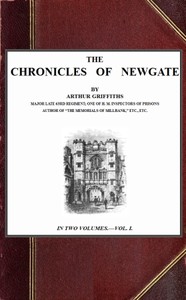
For The Chronicles of Newgate, vol. 1/2 — Edition Insights, the stored edition analysis reports 128,973 words, 9 hr 21 min estimated reading time, and 15 detected text sections.
The text analysis averages about 23.2 words per sentence, while the detected sections provide another way to judge how the source is divided.
Project Gutenberg metadata also associates the work with “Criminals -- Great Britain,” connecting these edition facts with the source record’s subject description.
Explore this collection
These alternatives are selected using recorded categories and estimated reading time.
About 575 minutes
Fantasy Juvenile Worlds
132,084 recorded words. 14 minutes difference from this book's estimate.
View Gutenberg source #27526About 584 minutes
Fantasy Juvenile Worlds
134,100 recorded words. 23 minutes difference from this book's estimate.
View Gutenberg source #53541About 616 minutes
Fantasy Juvenile Worlds
141,537 recorded words. 55 minutes difference from this book's estimate.
View Gutenberg source #12235Search stored excerpts and compare books → Choose by your preferences →
Choices use stored catalog measurements. Estimates vary with reading speed. A shared category is a catalog label, not a claim that two books have the same argument or literary quality.
Search reads excerpt text stored with this catalog and links to its associated Gutenberg record. The connection is stored in the site database; this tool does not recheck that every excerpt is word-for-word identical to that external record. Excerpt search does not cover every chapter and does not verify historical publication dates.
Catalog snapshot checked: 2026-09-25. Coverage: 90 public books, 90 available source excerpts.
Calculated from edition completeness, EPUB availability, text structure and catalogue metadata. Not a user rating.
Total of 100 points, scaled to a 2.5-5.0 range. Editions with an empty description or a missing EPUB file are not scored.
Public-domain source text
The source text is kept in the dedicated reader, separate from this catalogue record and its commentary.
Arthur Griffiths opens The Chronicles of Newgate, vol. 1/2 by acknowledging the overwhelming mass of materials he faced over nearly five years of research. He presents Newgate not as a static building but as an epitome of England's criminal history, where each era's crimes and punishments leave their mark. The preface sets a measured, scholarly tone, warning that a truly copious history would be wearisome, so he has selected prominent cases to convey a general impression. This framing immediately signals a work more concerned with representative patterns than exhaustive detail.
Griffiths writes as a former prison inspector, and his prose carries the weight of institutional knowledge. He refers to himself in the first person only in the preface; thereafter, the narrative voice becomes detached, marshaling facts with the authority of someone who has walked the cells. Yet he also adopts a storyteller's cadence when recounting executions, as in the passage describing the gallows at Smithfield and Tyburn. The shift between administrative report and historical anecdote creates a distinctive rhythm: one paragraph may detail the dimensions of a prison yard, the next narrate the last words of a condemned felon. This alternation keeps the reader alert to both the physical reality of Newgate and the human dramas it contained.
Griffiths devotes considerable space to the shifting locations of London's gallows, tracing how execution sites moved from Smithfield to St. Giles to Tyburn as the city expanded. He notes the confusion between Smithfield's Elms and Tyburn's elms, and cites Pennant, Loftie, and Waller on the etymology of Tyburn. The prose here is dense with place names and jurisdictional disputes—such as the 1580 conflict between the city and the Lieutenant of the Tower over where to hang R. Dod. Griffiths presents these episodes not as digressions but as evidence that the geography of punishment was contested ground, shaped by civic pride and legal authority as much as by penal theory.
The book's pace varies markedly between sections. In the preface, Griffiths warns that he has been compelled to reject much and epitomize what he uses, yet the text often lingers on specific cases or topographical minutiae. The passage on Tyburn, for instance, moves from etymology to the hanging of a Popish image in 1585 to Colonel Blood's plot to hang the Duke of Ormond—each detail adding a layer without advancing a single argument. This accumulative style can feel digressive, but it mirrors the author's stated method: to convey a general impression through selected instances. Readers should expect to move from broad statements about penal reform to sudden, vivid particulars, and to trust that the pattern will emerge over the long arc of the volume.
Griffiths's chronicle is best approached as a mosaic rather than a linear narrative. The excerpts suggest that the book rewards those who follow its associative leaps—from a prison inspector's note to a medieval execution site to a dispute over a gibbet. Readers interested in the texture of historical research will find the footnotes and citations a guide to further exploration, while those seeking a straightforward history may need to adjust to the author's deliberate, episodic pace.
That rainy afternoon, The Chronicles of Newgate left me sitting with the smell of damp paper and the terrible patience of its hangings. I kept thinking about how the body becomes evidence, how justice once measured itself in rope and stone. Then, idly, I reached for Aids to Forensic Medicine and Toxicology — Context and Discussion, and found the same quiet arithmetic, only written in wounds and poisons instead of prison walls.
Capture what you thought, learned, and would like to remember.