About 44 minutes
Golden rules of medical evidence — Context and Discussion
Fantasy Juvenile Worlds
9,940 recorded words. 4 minutes difference from this book's estimate.
View Gutenberg source #69556
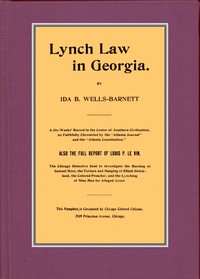
The source record for Lynch Law in Georgia — Reading Companion measures this digital text at 10,999 words, 48 min estimated reading time, and 2 detected text sections.
The text analysis averages about 20.2 words per sentence, while the detected sections provide another way to judge how the source is divided.
Project Gutenberg metadata also associates the work with “Hose, Sam, 1875-1899,” connecting these edition facts with the source record’s subject description.
Explore this collection
These alternatives are selected using recorded categories and estimated reading time.
About 44 minutes
Fantasy Juvenile Worlds
9,940 recorded words. 4 minutes difference from this book's estimate.
View Gutenberg source #69556About 86 minutes
Fantasy Juvenile Worlds
19,577 recorded words. 38 minutes difference from this book's estimate.
View Gutenberg source #4318About 86 minutes
Fantasy Juvenile Worlds
19,628 recorded words. 38 minutes difference from this book's estimate.
View Gutenberg source #17150Search stored excerpts and compare books → Choose by your preferences →
Choices use stored catalog measurements. Estimates vary with reading speed. A shared category is a catalog label, not a claim that two books have the same argument or literary quality.
Search reads excerpt text stored with this catalog and links to its associated Gutenberg record. The connection is stored in the site database; this tool does not recheck that every excerpt is word-for-word identical to that external record. Excerpt search does not cover every chapter and does not verify historical publication dates.
Catalog snapshot checked: 2026-09-25. Coverage: 90 public books, 90 available source excerpts.
Calculated from edition completeness, EPUB availability, text structure and catalogue metadata. Not a user rating.
Total of 100 points, scaled to a 2.5-5.0 range. Editions with an empty description or a missing EPUB file are not scored.
Public-domain source text
The source text is kept in the dedicated reader, separate from this catalogue record and its commentary.
Ida B. Wells-Barnett opens Lynch Law in Georgia with a direct challenge: “Consider the facts.” The pamphlet, published in 1899, chronicles twelve lynchings in Georgia over six weeks, culminating in the burning alive of Samuel Hose. Wells-Barnett does not simply narrate events; she juxtaposes two sources—the Atlanta newspapers that incited the mob and the report of detective Louis P. Le Vin, hired by Chicago’s Black citizens. This structure forces the reader to weigh the sensationalized press against sworn testimony. The detective’s account, which occupies the final chapter, systematically dismantles the official story: Hose killed his employer in self-defense, and the charge of assault was fabricated to justify a public burning. Wells-Barnett’s editorial voice is restrained but relentless, letting the documents speak while framing them with a clear moral purpose.
Wells-Barnett divides her pamphlet into four chapters, but the most striking structural choice is the shift from newspaper excerpts to detective report. Chapter I reprints articles from the Atlanta Journal and Atlanta Constitution that describe the lynchings with a tone of inevitability. The papers refer to “the reign of outlawry” as if it were a natural disaster. In contrast, Chapter IV presents Le Vin’s investigation in plain, declarative prose. He notes that white Georgians discussed the burning “with the freedom which one would talk about an afternoon’s divertisement.” The contrast is jarring: the newspapers use passive constructions and euphemisms, while Le Vin names names and quotes witnesses. Wells-Barnett never editorializes between these sections; the dissonance itself becomes her argument.
Louis P. Le Vin’s report is the pamphlet’s evidentiary core. He interviews white residents in Griffin, Newnan, and Atlanta, finding “no difficulty in securing interviews” because participants felt no need to conceal their roles. His account corrects specific falsehoods: Hose had worked for Alfred Cranford for two years, not a stranger; the murder occurred during a confrontation, not a stealth attack; and the assault charge was added after the fact. Le Vin also traces Hose’s background—his education, his care for his invalid mother—to humanize a man the press had reduced to a monster. Wells-Barnett includes these details not for sympathy but for precision. The report’s tone is clinical, almost legalistic, which makes the horror of the events more stark.
Throughout the pamphlet, Wells-Barnett highlights how language enables violence. The newspapers offer rewards for Hose’s capture “and then openly incite the people to burn him as soon as caught.” They invent the charge of outrage to justify the burning. In Chapter III, the account of Elijah Strickland’s lynching shows a mob that hesitates until a voice says, “We have got him here, let’s keep him.” The casual phrasing masks a decision to murder. Wells-Barnett also records the words of Major Thomas, who refuses to flee: “The muscles in my legs are not trained to running.” His defiance is a rare counterpoint, but it does not save Strickland. By preserving these voices—the mob’s, the victim’s, the lone dissenter’s—Wells-Barnett demonstrates how speech itself becomes a weapon or a shield.
The pamphlet’s rhythm accelerates as it moves from summary to specific cases. The opening chapter lists nine men lynched on suspicion of arson, each name a bullet point of violence. Then the narrative slows for Strickland’s hanging and Hose’s burning, drawing out the details of time and place. The detective’s report returns to a measured pace, methodically refuting each false claim. This alternation between speed and stillness mirrors the reader’s experience: the shock of the list, the horror of the scene, the relief of cold fact. Wells-Barnett controls tempo with precision, never lingering on gore but never rushing past the evidence.
Wells-Barnett’s pamphlet is a model of investigative journalism disguised as a polemic. She does not ask for pity but for justice, and she trusts that the facts, once laid out, will compel action. Readers should attend to the gaps between the newspaper accounts and the detective’s findings—those silences are where the truth hides. The pamphlet is short, but its method is enduring: gather the documents, compare them, and let the contradictions speak.
Reading Wells-Barnett’s careful unmaking of a headline’s lie, I remembered sitting with my grandfather’s old library handbook, the one on fair use that felt like a quiet argument for trust between strangers. Both books ask the same thing: look closer, question the story’s seams. That older volume, Reproduction of Copyrighted Works by Educators and Librarians — Text and Context, never raised its voice, yet it taught me how silence can protect a truth.
Create a short personal record of your experience with this book.