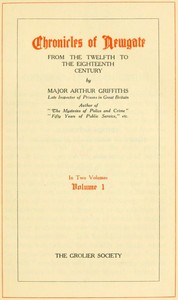
Arthur Griffiths, a late Inspector of Prisons in Great Britain, opens Chronicles of Newgate, Vol. 1 with a sweeping claim: “The combat with crime is as old as civilization.” The book then narrows its focus to a single institution, Newgate Prison, from the twelfth to the eighteenth century. Griffiths draws on official records, contemporary accounts, and his own professional experience to describe the prison’s physical layout, the routines of incarceration, and the public spectacles of punishment. The text moves between statistical data and vivid set-pieces, such as the execution of Colonel John Turner in 1662, which Griffiths reconstructs from Samuel Pepys’s diary and other sources.
Diction of Discipline and Spectacle
Griffiths’s vocabulary oscillates between the clinical and the theatrical. He describes punishments with a cataloguer’s precision—“the electric chair, the rope, the garotte”—but also with a relish for grim detail: “barbarous hacking of blunt swords in the hands of brutal or unskilful executioners.” The authorial voice is that of a Victorian administrator who has seen the inside of prisons, yet he does not suppress the macabre allure of his subject. When recounting the Tyburn gallows, he notes that the name became “the generic name for all places of execution,” used in York, Liverpool, and Dublin, as if the word itself carried a contagion of infamy. This blend of official tone and sensational content shapes the reader’s experience throughout.
The Geography of Execution: Tyburn’s Many Locations
One of the most precise threads in the narrative is the attempt to fix the exact site of the Tyburn gallows. Griffiths cites multiple authorities—Mr. Robins, Smith’s History of Marylebone, Mr. Loftie, and Mr. Waller—each offering a different location: the corner of Edgeware Road, Connaught Square, or a house in Upper Bryanston Street. He reports that “a careful but fruitless search” at Connaught Place produced only “a single bone, probably part of a human jaw-bone.” The passage reads like a detective’s report, weighing evidence and dismissing rumors. Griffiths also traces the etymology of “Tyburn” from “Teoburne” in a 951 charter to the later “Tye” and “bourne,” showing how the name migrated westward as London expanded. This topographical obsession grounds the book’s broader history in physical places.
Voices from the Record: Pepys and the Ordinary
Griffiths frequently lets contemporary witnesses speak, embedding their words within his own prose. The execution of Colonel Turner is narrated partly through Samuel Pepys, who “got to stand upon the wheel of a cart for a shilling in great pain above an hour before the execution was done.” Griffiths also mentions “the ordinary” (the prison chaplain) who accompanied Turner, delivering “long discourses and prayers one after another in hopes of a reprieve.” These borrowed voices give the account a diaristic immediacy. Elsewhere, Griffiths quotes from leases, charters, and antiquarian histories, creating a polyphonic texture. The effect is to make the reader feel that the past is not a single story but a clash of testimonies—official, personal, and legendary.
Elizabeth Fry and the Reformist Lens
Although the volume covers centuries before the nineteenth, Griffiths includes a section on Elizabeth Fry, the Quaker reformer who visited Newgate in 1813. He describes her “sympathies” being “aroused by the sadly neglected condition of the women’s quarters,” and notes that she “formed the Ladies’ Committee which secured many important reforms from Parliament.” This insertion is telling: Griffiths, a prison inspector himself, cannot resist foreshadowing the reforms that would eventually transform the penal system. The language here shifts from antiquarian to hortatory, praising Fry’s “hope and comfort.” The passage serves as a moral counterweight to the earlier catalogues of cruelty, suggesting that the chronicle of Newgate is also a story of gradual, if incomplete, humanization.
Readers should approach Chronicles of Newgate, Vol. 1 as a work of Victorian historiography as much as a history of a prison. Griffiths’s authorial choices—his blend of official data, anecdote, and moral commentary—reveal the assumptions of his era about crime, punishment, and progress. The book rewards attention to its footnotes and digressions, where the most telling details often lie.
There’s something oddly tender about old prison records, the way they trace how justice once stumbled through London’s streets. Reading Chronicles of Newgate, I kept thinking how law, for most of us, remains a distant rumor. That’s why Putnam's Handy Law Book for the Layman — Edition Insights feels like a quiet companion, translating that distant clatter into something almost friendly, a century removed.